
Certifications and Safety Standards for Gravity Water Filters
Predicament Measures is reader-supported: some links on this page are affiliate links, and as an Amazon Associate Predicament Measures earns from qualifying purchases at no extra cost to you. Learn more.
Gravity water filters need only a few marks with real weight: NSF/ANSI 42 for taste and odor claims, NSF/ANSI 53 for health-related contaminant reduction claims, and any electrical or battery certification only when the unit includes powered parts. If you want no-power use, the mark set changes less than the format does; if you need a battery, charger, or pump, verify those parts separately. Start by checking whether your own use depends on contaminant reduction, electrical safety, or both.
NSF/ANSI 42 Claims on Gravity Water Filters
NSF/ANSI 42 is the drinking-water standard for chlorine, taste, and odor claims. NSF International and ANSI publish it through a consensus process, and the mark tells you the claim was written for those aesthetic water changes, not for health protection.
That matters because a 42 mark does not say anything about bacteria, protozoa, lead, or other health-related contaminants. It also does not tell you how much water the filter holds, how fast it flows, or whether the chambers seal well.
For a kitchen pitcher used to reduce chlorine taste in tap water, 42 is the relevant mark. For a cabin system meant to handle uncertain source water, it is not enough by itself.
Where these choices show up in our reviews
From $108.98 to $367: 3 of the 15 in this category we have reviewed in full.


NSF/ANSI 53 Claims on Gravity Water Filters
NSF/ANSI 53 is the drinking-water standard for health-related contaminant reduction claims. NSF International and ANSI issue it, and the mark means the product has a claim tied to specific health concerns rather than only taste and odor.
This is the mark that matters when a gravity filter claims reduction of contaminants such as lead or cysts, because the standard is written for health effects. It does not guarantee that every contaminant listed in marketing copy is actually covered, and it does not tell you anything about storage size, flow rate, or fit between chambers.
If you are filtering water from a questionable source, 53 carries more decision weight than 42. The missing detail to check is the exact contaminant list, because the standard is claim-specific, not a blanket promise.
What the 0.2 µm pore size means for bacteria and protozoa
A 0.2 µm pore size is the category reference point for a gravity filter that can target bacteria and protozoa. It describes opening size, not storage capacity or flow rate, and it is one of the few figures that directly speaks to microbe control in this format.
That figure does not prove a complete health claim on its own. A filter can have a fine pore size and still lack a valid certification, a proper seal, or a verified claim set for the contaminants you care about.
What should you look for if bacteria or protozoa are the concern? You need a stated 0.2 µm pore size or a certification that explicitly names those organisms or the relevant reduction claim.
Stainless gravity systems and the Berkey-style benchmark
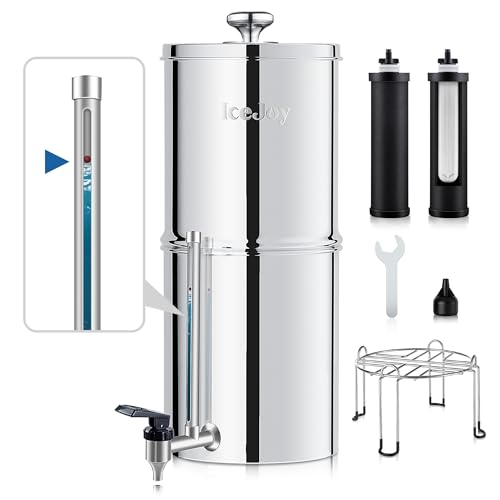
A Berkey-style stainless steel gravity system is the benchmark many buyers use for build, capacity, and element life. It is a reference tier, not a certification, so it helps with comparison but does not replace a safety mark.
Stainless steel tells you the housing material, not the contaminant claim. A stainless shell can still sit around uncertified elements, and a large chamber can still have weak documentation or poor chamber fit.
For a family that fills the upper chamber once in the morning and again after dinner, the useful question is not steel alone. It is whether the system has the right safety mark for the water source and a capacity that matches daily use.
Power and batteries inside gravity filters
Power and batteries inside gravity filters need their own safety marks when the product includes a charger, pump, UV lamp, or display. Those parts are covered by electrical safety and battery transport rules, while the finished water filter claim still depends on the drinking-water standard.
A powered add-on does not make the water claim stronger. It only adds another risk layer, because the electrical part can fail even when the filter media is certified.
For a gravity filter with a rechargeable pump, the mark on the battery or power supply matters separately from NSF/ANSI 42 or 53. If the listing names a battery but gives no electrical certification, treat that as an unresolved safety gap.
Gravity water filter safety failure modes and the marks that address them
Gravity water filters fail in a few predictable ways: unverified contaminant claims, slow flow rate, poor chamber sealing, and undersized capacity. NSF/ANSI 53 addresses the claim problem, NSF/ANSI 42 covers taste and odor claims, and neither one fixes a bad seal or a too-small reservoir.
Unverified contaminant claims and NSF/ANSI 53
Unverified contaminant claims are the biggest safety problem in this category. NSF/ANSI 53 addresses that risk when the listing names the exact contaminant reduction claim and the certification body can verify it.
The mark does not guarantee every marketing sentence on the box is true. It only supports the specific reduction claim tied to the standard and the exact test scope behind that claim.
Poor seal and bypass between chambers
Poor seal and bypass between chambers cause unfiltered water to slip around the media. No drinking-water standard by itself guarantees a perfect chamber fit, so you still need a listing that shows the parts are meant to mate correctly.
This is where a buyer should read the assembly details, not just the contaminant mark. A certified filter with a loose lid still creates a practical failure mode.
Slow flow rate and usable capacity
Slow flow rate makes the upper chamber sit full for hours, and undersized capacity forces frequent refilling. Neither NSF/ANSI 42 nor NSF/ANSI 53 tells you how fast the water passes through or how much the unit stores.
If your household fills bottles for a full day, capacity matters as much as certification. A small certified unit can still be the wrong choice if it cannot keep up with demand.
How do you verify the mark is real?
How do you verify the mark is real? Check the certifier name, the exact standard number, and the model-specific listing before you trust the box art.
- Look for NSF International, not a vague “tested to” phrase.
- Match the exact standard number to the claim: 42 for taste and odor, 53 for health-related reduction claims.
- Confirm the model name on the certification listing, not just the family name.
- Read the contaminant list, because a 53 mark can cover one substance and not another.
- Check whether the listing covers the whole unit or only a replacement element.
- If the product includes a battery, charger, or pump, look for a separate electrical or battery safety mark.
Which marks are non-negotiable for gravity water filters?
NSF/ANSI 53 is non-negotiable when you want health-related contaminant reduction claims, and NSF/ANSI 42 is the baseline when you only need taste and odor improvement. If the filter includes powered parts, the electrical or battery mark is also non-negotiable.
Everything else is secondary to the job you need done. Stainless steel construction, large capacity, and a familiar gravity format can all be useful, but they do not replace a real certification.
If you are choosing between two filters, prioritize the exact standard over the housing material. If the marks conflict with the features, trust the claim scope first and the convenience features second.
More Gravity Water Filter explainers and comparisons
- Choosing the Best Gravity Water Filter for Travel
- The Gravity Water Filters That Work Best for Small Kitchen Counters Under $200
- Which Gravity Water Filter Is Best for Apartments?
- Best Gravity Water Filter for Families
- Gravity Water Filters for Beginners Compared
- Which Gravity Water Filter Helps with Well Water Taste?
Related posts:
 Gravity Water Filter Explained: What It Is and How It Works
The Types of Gravity Water Filters, Explained
Gravity Water Filter Terms and Specs, Explained in Plain English
Gravity Water Filter Warranties: What to Check Before You Buy
Gravity Water Filter Alternatives: Other Ways to Get the Same Result
Filter Pore Size for Gravity Water Filters: How Much You Actually Need
Height for Gravity Water Filters: How to Choose Yours
Number Of Filter Elements for Gravity Water Filters: How Much You Actually Need