A radio scanner is a specialized electronic device that allows you to listen to two-way radio communications on various frequencies. It acts as a receiver that captures signals from public safety agencies, businesses, and hobbyist groups, converting those radio waves into audible sound. Unlike a standard two-way radio, a scanner does not transmit a signal; it is a passive listener designed to monitor multiple channels simultaneously.
The primary problem a radio scanner solves is the limitation of traditional radios, which usually only allow a user to listen to one pre-programmed channel at a time. In a complex environment where dozens of different agencies—such as fire, police, and EMS—operate on different frequencies, a single-channel radio would require the user to manually flip through dozens of stations to find the right one. A scanner automates this process, allowing a user to monitor a wide range of activity across a broad spectrum of frequencies from a single interface.
How does a radio scanner work?
A radio scanner works by capturing, filtering, and decoding radio waves in a linear progression of steps:
- Signal Reception: The scanner’s antenna captures electromagnetic waves traveling through the air. The antenna’s physical design determines which frequencies it can “see” most effectively.
- Frequency Filtering: The internal circuitry isolates the specific frequency the user has selected, blocking out all other surrounding radio noise to prevent interference.
- Demodulation: The device extracts the audio information from the radio wave. For analog signals, this is a direct conversion; for digital signals, the scanner must identify the specific modulation type.
- Digital Decoding: If the signal is digital (such as P25 or DMR), the scanner’s processor must strip away the data packets and “rebuild” the voice audio. This requires the scanner to have specific hardware support for that protocol.
- Audio Output: The processed signal is sent to a speaker or headphone jack, allowing the user to hear the communication in real-time.
Radio Scanners we have reviewed in detail
Prices across these 3 run from $118.70 to $699.99; each one has a full review here.

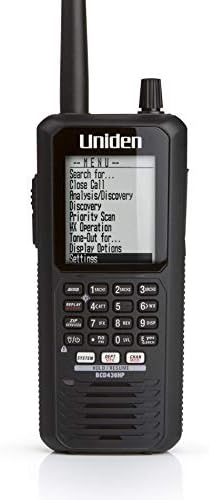

Uniden Bearcat BC75XLT Handheld Scanner
$129.99 price checked August 2026
If you need to understand the technical jargon, view common radio scanner terms and specifications to clarify the common industry lingo.
What terms matter when choosing a scanner?
Understanding the vocabulary of radio scanning helps determine which features are necessary for a specific environment. Each of these terms changes how much information a scanner can provide.
Digital Standards (P25, DMR, NXDN)
Digital standards are the protocols used to transmit voice data over radio waves. P25 Phase I and Phase II are the primary digital standards for public safety communications in North America. DMR and NXDN are common digital standards for business and industrial radio. If a scanner lacks support for a specific standard, the user will hear only “digital noise” or “data bursts” instead of clear voice audio.
Trunking vs. Conventional Systems
The difference between trunking and conventional systems determines if a scanner can follow a system that dynamically assigns frequencies or only monitors fixed ones. In a conventional system, a group of users stays on one specific frequency. In a trunked system, a computer controller assigns a pool of frequencies to different talkgroups as needed. To follow these, a scanner needs TrunkTracker technology to automatically hop between frequencies as the system moves the conversation.
Memory Channels and Capacity
Memory channels refer to the number of pre-programmed systems or frequencies the scanner can store. This is different from the number of active channels the scanner can monitor at once. If a scanner has insufficient memory channels, a user cannot store enough system IDs to monitor multiple agencies in a large city.
Reference Tiers and Infrastructure
Reference tiers define the upper limits of consumer scanning technology. High-end professional units like the Uniden SDS100 and Whistler TRX-1 define the top of the consumer market. These units are designed to emulate the protocols used by Icom and Motorola professional infrastructure, which is the industrial hardware used by large-scale public safety and commercial networks.
What does having a scanner change in practice?
Having a radio scanner changes your ability to monitor local activity in real-time, providing a window into public safety and industrial operations that is not available to the general public. In a practical sense, this means being able to hear emergency dispatches as they happen, which can provide situational awareness during local events or weather emergencies.
Where the difference shows up
The difference shows up most clearly in large metropolitan areas where trunked systems are the norm. A scanner with the correct digital decoding and trunking capabilities allows you to follow an entire city’s public safety network. It also provides a way to monitor hobbyist “simplex” channels, where people use local, unrepeatered frequencies to talk to one another nearby.
Where the difference does not show up
The difference does not show up in areas where agencies use heavy encryption. If a radio system is encrypted, no consumer scanner can decode the audio, regardless of the scanner’s specs. Additionally, a scanner does not provide a “live feed” like a website; you must be within a reasonable geographical distance of the transmitter to receive the signal. If you are too far away, the scanner will only hear “out of range” fragments.
Who needs a radio scanner?
A radio scanner is a tool for specific types of users who require real-time information or have a hobbyist interest in radio technology.
Who ends up needing one
Individuals who live in areas with high emergency activity, such as near major highways or industrial zones, often need a scanner for situational awareness. Hobbyists who enjoy the technical side of radio—learning about frequencies, signal types, and hardware—also find scanners to be a primary tool for exploration. Additionally, those who want to monitor local business communications or private radio networks for hobbyist purposes find scanners essential.
Who does not need one
A radio scanner is not needed by people who only want to listen to pre-recorded content or those who live in areas where public safety agencies do not use radio for dispatch. If an agency has moved entirely to a closed, encrypted cellular network for all communications, a scanner will not provide any information. Furthermore, if you do not have an interest in the technical process of radio monitoring, the complexity of programming and managing frequencies may not justify the purchase.
The other Radio Scanner guides we have published
Related posts:
 The Types of Radio Scanners, Explained
Radio Scanner Terms and Specs, Explained in Plain English
Radio Scanner Warranties: What to Check Before You Buy
Radio Scanner Alternatives: Other Ways to Get the Same Result
Dynamically Allocated Channels for Radio Scanners: How Much You Actually Need
P25 Phase Support for Radio Scanners: How Much You Actually Need
Weight for Radio Scanners: How Much You Actually Need
Continuous Output for Emergency Power Supplies: How Much You Actually Need
The Types of Radio Scanners, Explained
Radio Scanner Terms and Specs, Explained in Plain English
Radio Scanner Warranties: What to Check Before You Buy
Radio Scanner Alternatives: Other Ways to Get the Same Result
Dynamically Allocated Channels for Radio Scanners: How Much You Actually Need
P25 Phase Support for Radio Scanners: How Much You Actually Need
Weight for Radio Scanners: How Much You Actually Need
Continuous Output for Emergency Power Supplies: How Much You Actually Need