Off-grid solar panels are categorized by their cell architecture and material composition, which determine how they convert sunlight into electricity. These technical differences dictate the panel’s efficiency, heat tolerance, and physical durability. Choosing between these types depends on whether you prioritize maximum power output in a small footprint, long-term resilience in extreme weather, or a lower initial cost for a larger installation area.
Monocrystalline Solar Panels
Monocrystalline solar panels use a single, continuous crystal structure to facilitate electron flow. This design allows these panels to achieve higher conversion efficiencies, often exceeding 20% in modern manufacturing. If you have limited roof space or a small ground area for an off-grid system, monocrystalline panels are the standard choice because they produce more power per square meter than other types.
These panels perform well in various conditions but can experience a slight drop in efficiency as temperatures rise. They typically feature a uniform dark color, which helps with heat absorption. While they sit at a higher price point than polycrystalline options, the increased power density often makes them the most cost-effective choice for compact off-grid setups.
Where these choices show up in our reviews
Prices across these 3 run from $119.95 to $399.99; each one has a full review here.

Calpha 200W 20V Monocrystalline Solar Panel
If you are planning a road trip, see our top picks for caravan solar power.
$139.99 price checked August 2026

Flexible Monocrystalline Solar Panel 100W 12V
$399.99 price checked August 2026
For smaller setups, explore compact panels for charging batteries.
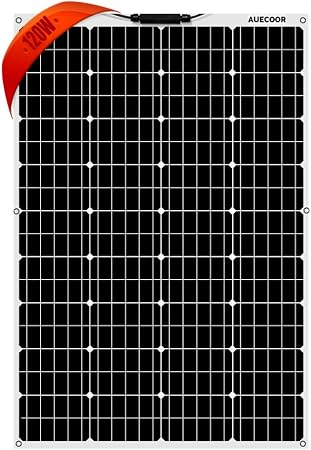
AUECOOR 120 Watts 12 Volts Flexible Solar Panel
$119.95 price checked August 2026
Newcomers can learn how off-grid solar technology functions before making a purchase.
Polycrystalline Solar Panels
Polycrystalline solar panels are made by melting and cooling multiple silicon fragments into a single block, creating a mosaic-like appearance. This manufacturing process is less precise than the monocrystalline method, resulting in lower conversion efficiencies, typically ranging between 15% and 17%. These panels are suited for users who have ample space and want to lower the initial capital expenditure of their solar array.
Because they require less energy to manufacture, polycrystalline panels are generally more affordable. They perform adequately in most climates but require a larger surface area to generate the same amount of electricity as a monocrystalline system. If your project allows for a larger footprint, these panels provide a straightforward way to scale up power without the premium cost of high-efficiency cells.
Thin-Film Solar Panels
Thin-Film Materials
Thin-film solar panels are made by depositing layers of photovoltaic material, such as cadmium telluride (CdTe) or copper indium gallium selenide (CIGS), onto a substrate like glass, metal, or plastic. Unlike crystalline panels, these do not use thick silicon wafers. They are ideal for applications where weight and flexibility are more important than high efficiency, such as portable off-grid power or curved surfaces.
To simplify the technical data, view our guide to solar panel specifications.
Performance Benefits
Thin-film panels excel in low-light conditions and high-heat environments because they have a lower temperature coefficient than crystalline models. They are also much lighter and more flexible. However, they have lower efficiency ratings and degrade faster over time. These panels sit at a lower price point per watt for large-scale industrial use, but they are often less economical for small-scale residential off-grid systems due to the large area required to meet power demands.
Comparison of Off-Grid Solar Panel Types
| Panel Type | Best-Fit Buyer | Main Advantage | Main Compromise |
|---|---|---|---|
| Monocrystalline | Limited space / High efficiency | Highest power density | Higher initial cost |
| Polycrystalline | Large area / Budget conscious | Lower manufacturing cost | Lower efficiency per square meter |
| Thin-Film | Portable / Flexible needs | Heat and low-light tolerance | Rapid degradation / Low efficiency |
Which Off-Grid Solar Panel Type Fits Your Situation?
To determine which type of off-grid solar panel suits your needs, you should evaluate your available space and local climate conditions. If you are installing a system on a residential roof with limited dimensions, monocrystalline panels are the standard choice to ensure you capture enough energy from the available surface area.
If you are building a large-scale ground mount system where land is plentiful, polycrystalline panels may allow you to reach your power goals at a lower total cost. These are often used in rural settings where the goal is to maximize total output across a large acreage rather than maximizing the output of a single panel.
For portable off-grid applications, such as powering a remote campsite or a van, thin-film panels are a viable option due to their weight and durability. However, if your system must survive extreme heat or frequent shading, you should check the temperature coefficients and low-light performance ratings of the specific technology before ordering. For all installations, you must confirm that your mounting surface can support the weight of the panels and that a qualified installer is available to handle the electrical integration according to local regulations.
Browse our other Off-grid Solar pages
- The Off Grid Solar Panels That Work Best for 12V Systems
- Which Waterproof Solar Panels Are Best for Outdoor Use?
- Best Small Solar Panels for Battery Charging
- Entry Level Off Grid Solar Panels for Home Backup Compared
- Which Off Grid Solar Panels Are Best for RVs?
- Best Flexible Solar Panels for Camping
Related posts:
 Off-Grid Solar Panel Explained: What It Is and How It Works
Off-Grid Solar Panel Terms and Specs, Explained in Plain English
Off-Grid Solar Panel Warranties: What to Check Before You Buy
Certifications and Safety Standards for Off-Grid Solar Panels
Off-Grid Solar Panel Alternatives: Other Ways to Get the Same Result
Rated Power for Off-Grid Solar Panels: How Much You Actually Need
Operating Voltage for Off-Grid Solar Panels: How to Choose Yours
Panel Dimensions for Off-Grid Solar Panels: How to Choose Yours
Off-Grid Solar Panel Explained: What It Is and How It Works
Off-Grid Solar Panel Terms and Specs, Explained in Plain English
Off-Grid Solar Panel Warranties: What to Check Before You Buy
Certifications and Safety Standards for Off-Grid Solar Panels
Off-Grid Solar Panel Alternatives: Other Ways to Get the Same Result
Rated Power for Off-Grid Solar Panels: How Much You Actually Need
Operating Voltage for Off-Grid Solar Panels: How to Choose Yours
Panel Dimensions for Off-Grid Solar Panels: How to Choose Yours