When researching off-grid solar panels, most technical specifications directly impact your daily power yield, while others are marketing descriptors that do not change how much electricity you generate. Load-bearing terms include wattage, voltage, and efficiency ratings, as these dictate the size of the system you need to buy. You can largely ignore aesthetic descriptions or “advanced” branding that lacks a corresponding numerical value. Understanding these metrics ensures you do not under-provision your system, which leads to dead batteries, or over-buy, which wastes your budget on unused capacity.
Off-Grid Solar Power Capacity Terms
Off-grid solar power capacity defines how much energy a panel can produce under specific conditions. These numbers determine the size of the array you need to build to meet your energy demands.
- Wattage (W) – This measures the maximum power output of a panel under standard test conditions. A higher wattage means the panel can generate more electricity in the same amount of sunlight, allowing you to use fewer panels to reach your goal.
- Maximum Power (Pmax) – This is the peak output of the panel, usually listed in Watts (W) or Kilowatts (kW). You should prioritize higher Pmax values to increase the total power available to your battery bank.
- Operating Voltage (Vmp) – This is the voltage at which the panel produces its maximum power. You must match this to your charge controller’s input range; a higher voltage allows for longer cable runs but requires a controller that can handle the specific range.
- Short Circuit Current (Isc) – This is the maximum current the panel can provide if the circuit is closed. You need to ensure your wiring and fuses are rated higher than this value to prevent melting or fire hazards.
- Efficiency (%) – This measures how much of the sunlight hitting the panel surface is converted into electricity. Higher efficiency percentages mean you can produce more power in a smaller physical footprint, which is useful if your mounting space is limited.
Where these choices show up in our reviews
These 3 have their own full review on this site, and run from $119.95 to $399.99.

Flexible Monocrystalline Solar Panel 100W 12V
$399.99 price checked August 2026
If you are on a budget, you can compare the best entry-level off grid solar panels for home backup to see which models offer the most value.
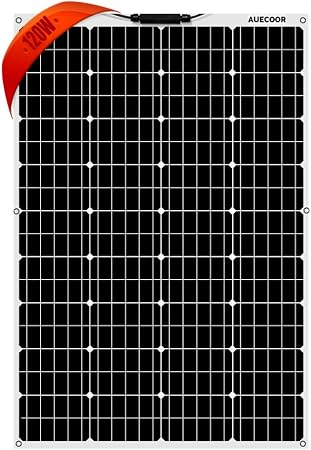
AUECOOR 120 Watts 12 Volts Flexible Solar Panel
$119.95 price checked August 2026
For those needing portability, we have a guide on the best flexible solar panels for camping setups.
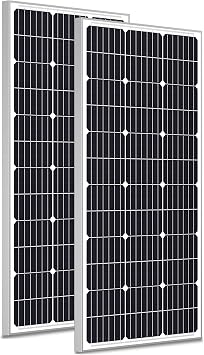
SOLPERK 200W Monocrystalline Solar Panel
$169.99 price checked August 2026
You can learn more about the different technologies by exploring the various types of off-grid solar panels available.
Off-Grid Solar Panel Physical Specifications
Off-grid solar panel physical specifications dictate how the hardware fits on your roof, ground mount, or vehicle. These measurements are essential for planning your mounting hardware and ensuring the panels can withstand local weather.
- Dimensions (Length x Width) – These are the physical measurements of the panel frame. You must measure your available space carefully to ensure the panels fit, and you should account for a small gap between panels for airflow.
- Weight (kg/lbs) – This is the total weight of the panel including the frame and glass. You need to know this to ensure your mounting structure or roof can support the load, especially when multiple panels are grouped together.
- Module Type (Monocrystalline vs. Polycrystalline) – Monocrystalline panels are made from a single crystal structure and generally offer higher efficiency in smaller spaces. Polycrystalline panels are often less expensive but require more surface area to produce the same amount of power.
- Temperature Coefficient – This number indicates how much the power output drops as the panel gets hot. A lower (closer to zero) temperature coefficient is better, as it means the panel maintains more of its rated power during hot summer days.
- Impact Rating / Glass Thickness – This describes the durability of the front surface against hail or debris. Look for specific glass thickness measurements (e.g., 3.2mm) to ensure the panels can survive your local weather conditions.
Off-Grid Solar Compatibility and Standards
Off-grid solar compatibility and standards ensure that the panels you buy will safely communicate with your batteries, inverters, and charge controllers. Matching these specs prevents equipment damage and system failure.
To understand the underlying mechanics first, see how an off-grid solar panel works in our foundational guide.
- Maximum System Voltage (Voc) – This is the “Open Circuit Voltage” or the maximum voltage the panel produces in cold weather. You must ensure your charge controller can handle this specific voltage to avoid frying the electronics.
- IP Rating (e.g., IP67, IP68) – This measures the panel’s resistance to dust and water ingress. A higher IP rating means the panel is better sealed against heavy rain or snow, which is vital for outdoor off-grid installations.
- Connectors (MC4, etc.) – These are the standard plugs used to link panels together. Using the same standard across all panels ensures you can easily daisy-chain them without needing specialized adapters.
- Bypass Diodes – These are internal components that allow electricity to flow around a shaded cell. More bypass diodes (or specific bypass configurations) are better for systems where parts of the panel might be shaded by trees or chimneys.
- Load Type (Standalone vs. Grid-Tied) – Standalone panels are designed specifically for off-grid use with batteries. You should ensure the panels are rated for off-grid applications to ensure the electrical characteristics match your battery-based system.
Commonly Confused Off-Grid Solar Terms
Off-grid solar buyers often confuse several terms that sound similar but serve very different roles in a power system.
Wattage vs. Watt-Hours
Wattage (W) is the instantaneous power the panel produces at any given moment, like the speed of a car. Watt-hours (Wh) is the total amount of energy produced over time, like the distance the car traveled. You need a specific number of Watts to charge your batteries, but you calculate your daily needs in Watt-hours.
Voltage vs. Amperage
Voltage (V) is the electrical pressure, while Amperage (A) is the volume of electricity flowing through the wire. A panel might have a high voltage but low amperage; you must ensure your charge controller can handle the voltage while your wires are thick enough to carry the amperage.
Efficiency vs. Wattage
Efficiency is a ratio of how well a panel uses the sun, while Wattage is the final result of that efficiency. A high-efficiency panel might have a lower total wattage if it is physically smaller than a low-efficiency panel of the same size.
Browse our other Off-grid Solar pages
Related posts:
 Off-Grid Solar Panel Explained: What It Is and How It Works
The Types of Off-Grid Solar Panels, Explained
Off-Grid Solar Panel Warranties: What to Check Before You Buy
Certifications and Safety Standards for Off-Grid Solar Panels
Off-Grid Solar Panel Alternatives: Other Ways to Get the Same Result
Rated Power for Off-Grid Solar Panels: How Much You Actually Need
Operating Voltage for Off-Grid Solar Panels: How to Choose Yours
Panel Dimensions for Off-Grid Solar Panels: How to Choose Yours
Off-Grid Solar Panel Explained: What It Is and How It Works
The Types of Off-Grid Solar Panels, Explained
Off-Grid Solar Panel Warranties: What to Check Before You Buy
Certifications and Safety Standards for Off-Grid Solar Panels
Off-Grid Solar Panel Alternatives: Other Ways to Get the Same Result
Rated Power for Off-Grid Solar Panels: How Much You Actually Need
Operating Voltage for Off-Grid Solar Panels: How to Choose Yours
Panel Dimensions for Off-Grid Solar Panels: How to Choose Yours