For most off-grid solar panels, a cell efficiency rating between 20% and 22% represents the standard target for reliable power production. You should aim for these figures unless your installation area is extremely limited, in which case 23% or higher becomes a priority.
Recommended Efficiency for Off-Grid Solar Panels by Use Case
| Use Case | Recommended Efficiency | Why this number |
|---|---|---|
| Small Cabin / Shed | 18% – 20% | Lower efficiency is acceptable when you have ample roof or ground space to mount a larger number of panels. |
| Standard Residential Off-Grid | 20% – 22% | This range balances a reasonable cost per watt with a high enough output to power standard household appliances. |
| Limited Roof Space | 22% – 23% | Higher efficiency allows you to generate more power per square meter, which is necessary when your mounting area is fixed. |
| High-Output Commercial/Agri | 23%+ | Maximum efficiency is required to minimize the footprint of large-scale arrays where land costs or structural limits are high. |
Where these choices show up in our reviews
From $119.95 to $399.99: the 3 in this category we have reviewed in full.


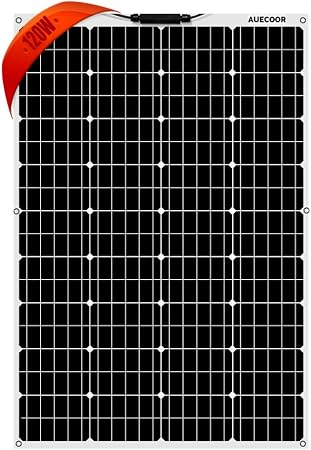
AUECOOR 120 Watts 12 Volts Flexible Solar Panel
$119.95 price checked August 2026
Read our full AUECOOR Flexible Solar Panel review
If you are on a budget, compare the best entry-level off grid solar panels to see which power solution fits your home backup needs.
What Happens if You Under-Provision or Over-Buy Off-Grid Solar Panels?
Under-provisioning off-grid solar panels occurs when the total wattage produced by your panels fails to meet your daily energy consumption requirements. If your system produces less energy than you use, your battery bank will drain faster than it can recharge, leading to power outages during periods of low sunlight or heavy usage.
Risks of Low Efficiency and Low Wattage
If you choose panels with low efficiency and do not compensate by adding more units, your system will struggle to maintain a state of charge. This is particularly problematic in regions with shorter winter days or frequent cloud cover, where every percentage point of efficiency contributes to the “buffer” of energy stored in your batteries.
The Real Cost of Over-Buying Off-Grid Solar Panels
Over-buying off-grid solar panels happens when you install significantly more wattage than your battery bank or inverter can actually handle. While it might seem like “extra” power is a safety net, it often results in wasted energy and unnecessary expenditure.
Wasted Energy and Inverter Limits
Most off-grid inverters have a maximum input limit. If your panels produce 3,000 watts but your inverter is only rated to handle 2,000 watts of solar input, the excess 1,000 watts is simply lost. You pay for the hardware and the installation of those extra panels without receiving any usable electricity in return.
Increased Upfront Capital Expenditure
Buying high-efficiency panels when you have plenty of space is a common way to overspend. If you have 100 square meters of land, a 19% efficient panel that costs less per watt is often a better investment than a 23% efficient panel that costs significantly more per watt. You are paying a premium for efficiency that your specific site does not require.
The Efficiency Mistake and What to Optimize Instead
A common mistake when selecting off-grid solar panels is focusing exclusively on the highest efficiency percentage available without calculating the total available surface area. Many buyers assume a higher percentage is always better, but efficiency is a measure of density, not total output.
Prioritizing Total Wattage over Percentages
You should optimize for the total wattage your site can physically accommodate. If your roof can hold 20 panels, a 20% efficient panel provides a specific amount of power. A 23% efficient panel provides more, but it also costs more. If your goal is simply to power a shed, the cheaper, lower-efficiency panel is the more logical choice because you have the space to make up for the lower percentage.
Calculating the Cost per Watt
Instead of looking at the efficiency percentage in isolation, calculate the cost per watt of the total system. If the jump from 21% to 23% efficiency increases the price of the panels by 30%, but only increases the power output by 10%, you are paying a high premium for a marginal gain. Only prioritize high efficiency when you have reached the physical limit of your installation area.
How Efficiency Interacts with Other Off-Grid Solar Panel Specs
Efficiency interacts with the physical dimensions and electrical characteristics of the panels, creating limits on where a high efficiency figure actually provides value. A high efficiency rating is only useful if the rest of your system can support the power it generates.
Inverter and Charge Controller Limits
High-efficiency panels often produce higher current (amperage) for the same amount of sunlight. If your charge controller is rated for 60 amps, but your high-efficiency panels produce 80 amps in peak sun, the controller will become a bottleneck. In this scenario, the high efficiency of the panels is wasted because the electronics cannot process the electricity fast enough.
Temperature Coefficients and Heat
Efficiency ratings are usually measured at Standard Test Conditions (STC), which involve specific temperatures. In hot climates, the “real-world” efficiency of a panel can drop significantly. When comparing panels, look at the temperature coefficient. A panel with 22% efficiency that loses 0.3% of its power for every degree over 25C may perform worse in the desert than a 20% efficient panel with a better temperature rating.
Physical Footprint and Weight
Higher efficiency usually means smaller cells and more compact frames. If you are mounting panels on a structure with strict weight limits or very narrow mounting rails, high-efficiency panels are a technical necessity. In these cases, the efficiency rating is the primary constraint, as it allows you to fit the required wattage into a space that would otherwise be too small for standard panels.
Professional Installation and Local Rules
Regardless of the efficiency you choose, the physical installation of off-grid solar panels requires careful mounting and electrical integration. You must confirm your mounting surface can support the weight of the panels and ensure all wiring meets local electrical codes. Because of the complexities of high-voltage DC systems and structural mounting, you should hire a qualified installer to perform the final installation and ensure the system is safe and compliant with local regulations.
Browse our other Off-grid Solar pages
- Off Grid Solar Panels for Boats Compared
- Choosing the Best Off Grid Solar Panels for Caravans
- The Off Grid Solar Panels That Work Best for 12V Systems
- Which Waterproof Solar Panels Are Best for Outdoor Use?
- Best Small Solar Panels for Battery Charging
- Entry Level Off Grid Solar Panels for Home Backup Compared
Related posts:
 Off-Grid Solar Panel Explained: What It Is and How It Works
The Types of Off-Grid Solar Panels, Explained
Off-Grid Solar Panel Terms and Specs, Explained in Plain English
Off-Grid Solar Panel Warranties: What to Check Before You Buy
Certifications and Safety Standards for Off-Grid Solar Panels
Off-Grid Solar Panel Alternatives: Other Ways to Get the Same Result
Rated Power for Off-Grid Solar Panels: How Much You Actually Need
Operating Voltage for Off-Grid Solar Panels: How to Choose Yours
Off-Grid Solar Panel Explained: What It Is and How It Works
The Types of Off-Grid Solar Panels, Explained
Off-Grid Solar Panel Terms and Specs, Explained in Plain English
Off-Grid Solar Panel Warranties: What to Check Before You Buy
Certifications and Safety Standards for Off-Grid Solar Panels
Off-Grid Solar Panel Alternatives: Other Ways to Get the Same Result
Rated Power for Off-Grid Solar Panels: How Much You Actually Need
Operating Voltage for Off-Grid Solar Panels: How to Choose Yours