Off-grid solar panels are photovoltaic modules designed to capture sunlight and convert it into electricity for use in locations not connected to a public utility grid. These panels serve as the primary energy generation source for remote cabins, RVs, and independent power systems, providing a way to run electronics, lights, and appliances using only the energy harvested from the sun.
The problem these systems solve is the lack of access to reliable infrastructure in rural or mobile environments. Without a connection to the city’s power lines, a user must generate their own electricity on-site. Off-grid solar provides a way to create a self-sustaining power loop where energy is harvested during the day, stored for use at night, and managed independently of external utility companies or fluctuating fuel costs.
How Do Off-Grid Solar Panels Work?
Off-grid solar panels work by converting photons from sunlight into a flow of direct current (DC) electricity through the photovoltaic effect. This process follows a specific sequence of energy conversion and distribution:
- Solar panels capture sunlight and generate DC electricity as electrons move through the silicon cells.
- A charge controller regulates the voltage and current coming from the panels to prevent overcharging the storage system.
- The electricity flows into a battery bank, which stores the energy for use during periods of low sunlight or at night.
- An inverter converts the stored DC electricity into alternating current (AC), which is the standard form of power used by most household appliances.
- The user draws power from the AC output, completing the circuit from the sun to the device.
Off-grid Solar Panels we have reviewed in detail
Prices across these 3 run from $139.99 to $399.99; each one has a full review here.
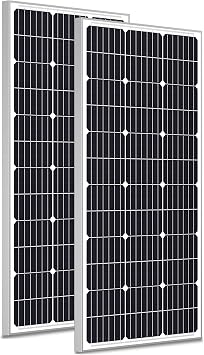
SOLPERK 200W Monocrystalline Solar Panel
$169.99 price checked August 2026
Read our full SOLPERK 200W Solar Panel review
If you are planning a maritime setup, see our comparison of the best off grid solar panels for boats.


Flexible Monocrystalline Solar Panel 100W 12V
$399.99 price checked August 2026
Read our full 100W Flexible Solar Panel review
Understanding technical data is easier when you view the off-grid solar panel terms and specs explained.
What Components Matter in an Off-Grid Solar System?
The components that matter in an off-grid solar system determine the total capacity, reliability, and cost of the power supply. Each part handles a specific stage of the energy transition.
Photovoltaic Modules
Photovoltaic modules, commonly called solar panels, are the first stage of the system. The wattage rating of these modules determines how much power the system can produce per hour under ideal conditions. Higher wattage panels allow for a smaller physical footprint to achieve the same power output.
Charge Controllers
Charge controllers manage the flow of electricity between the panels and the batteries. They prevent the batteries from being damaged by overcharging or deep discharging. For systems with large fluctuations in sunlight, Maximum Power Point Tracking (MPPT) controllers are used to extract the most efficient amount of power from the panels at any given moment.
Battery Storage
Battery storage acts as the reservoir for the system. The capacity, measured in Amp-hours (Ah) or Watt-hours (Wh), determines how long the system can run without sun. Lead-acid and lithium-ion are the most common chemistries, each offering different lifespans and depth-of-discharge limits.
Power Inverters
Power inverters change the type of electricity the system provides. Since most modern electronics require AC power, the inverter must be sized to handle the “surge” or “startup” requirements of heavy items like refrigerators or power tools. A “pure sine wave” inverter is the standard for ensuring electronics run without noise or damage.
What Does Having Off-Grid Solar Change in Practice?
Having off-grid solar changes the way a user manages their energy consumption by moving from a “limitless” supply to a “managed” supply. In a grid-tied home, a user might leave a light on indefinitely; in an off-grid setup, the user must balance their daily energy “budget” against the amount of sunlight received that day.
You can also learn about the different technologies by reading the various types of off-grid solar panels explained.
Energy Budgeting
The most significant change is the need for load management. If a user knows their battery bank holds 2,000Wh of energy, they must ensure that the total energy used by their devices does not exceed that amount before the next sunrise. This often involves prioritizing essential loads like refrigeration over high-draw items like space heaters.
Location Limits
Off-grid solar does not provide a solution for high-demand heating or cooling in extreme climates. Because solar energy is limited by the surface area of the panels and the hours of usable sunlight, it is often insufficient to run high-wattage HVAC systems. In these cases, solar is used to power auxiliary electronics while a secondary heat source is used for temperature control.
Who Needs Off-Grid Solar Panels?
The need for off-grid solar panels is defined by the presence of a power requirement in a location without utility access or the desire for total energy independence.
Remote Locations
Individuals who own cabins, remote work sites, or off-grid homesteads need these systems because extending the public power grid to these locations is often cost-prohibitive. These users require a system sized specifically to their peak daily load and the average solar exposure of their specific geography.
Mobile Power
Users of RVs, boats, or overland vehicles need off-grid solar to maintain battery levels while traveling. For these users, the priority is often “trickle charging” or maintaining a constant state of charge for electronics and lights while the vehicle is stationary or moving.
Who Does Not Need It
Users with easy access to a stable municipal power grid generally do not need off-grid solar panels unless they are seeking a redundant backup system. For these users, a “grid-tied” system or a standard gas-powered generator is usually the more efficient choice for meeting high-power demands.
Before ordering any off-grid solar components, a buyer must calculate their total daily watt-hour consumption and confirm that the chosen battery capacity and panel wattage can meet that demand based on local sunlight averages. Because off-grid systems involve high-voltage electricity and specific mounting requirements, the installation should be performed by a qualified professional to ensure the system meets local electrical codes and safety standards.
The other Off-grid Solar guides we have published
Related posts:
 The Types of Off-Grid Solar Panels, Explained
Off-Grid Solar Panel Terms and Specs, Explained in Plain English
Off-Grid Solar Panel Warranties: What to Check Before You Buy
Certifications and Safety Standards for Off-Grid Solar Panels
Off-Grid Solar Panel Alternatives: Other Ways to Get the Same Result
Rated Power for Off-Grid Solar Panels: How Much You Actually Need
Operating Voltage for Off-Grid Solar Panels: How to Choose Yours
Panel Dimensions for Off-Grid Solar Panels: How to Choose Yours
The Types of Off-Grid Solar Panels, Explained
Off-Grid Solar Panel Terms and Specs, Explained in Plain English
Off-Grid Solar Panel Warranties: What to Check Before You Buy
Certifications and Safety Standards for Off-Grid Solar Panels
Off-Grid Solar Panel Alternatives: Other Ways to Get the Same Result
Rated Power for Off-Grid Solar Panels: How Much You Actually Need
Operating Voltage for Off-Grid Solar Panels: How to Choose Yours
Panel Dimensions for Off-Grid Solar Panels: How to Choose Yours