
What should a buyer check about the WD-TK-A-FS gravity water filter’s certifications and filter claims before expecting it to reduce chlorine, fluoride, and heavy metals?
Predicament Measures is reader-supported: some links on this page are affiliate links, and as an Amazon Associate Predicament Measures earns from qualifying purchases at no extra cost to you. Learn more.
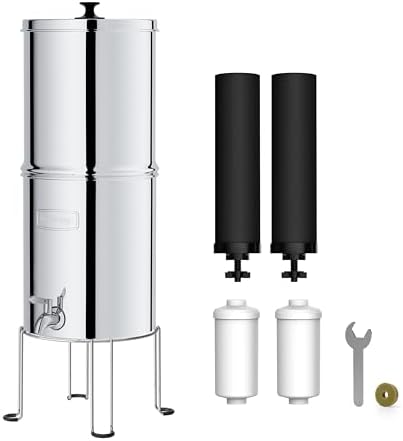
We compared the gravity water filter options for those claims, and this one lists IAPMO R&T against NSF/ANSI 372, NSF/ANSI 42, and up to 99% contaminant removal.
For a comprehensive data breakdown of the unit, see our full WD-TK-A-FS review.
For that answer to hold, you need the right flow path, enough clearance for a 12.6-inch-tall countertop unit, and no extra sediment load that would clog the cartridges early. Start by checking the water source you plan to use, since a Gravity Water Filter depends on slow contact time, not pressure.
You can find answers to common user questions in the WD-TK-A-FS frequently asked questions.
What to Check Before Buying the WD-TK-A-FS
- Check the certification language. NSF/ANSI 42 covers chlorine, taste, and odor claims, while NSF/ANSI 372 is about lead-free materials.
- Check whether the fluoride claim is tied to a specific filter set. This listing links the 1,000-gallon fluoride life to two white filters.
- Check whether your water needs sediment pre-filtration. Large particles can clog the main cartridges before the coconut activated carbon does its chemical work.
- Check the space under cabinets and around the base. A 2.25-gallon countertop system still needs room for drainage and air circulation.
- Check your refill pattern against the 2.25-gallon capacity. That size suits lighter daily use better than a household that drinks heavily all day.
- Check the faucet-flush step in your setup. This model calls for a 1-minute flush before use, so your first setup should allow that step.
Where the WD-TK-A-FS Fits Among Gravity Water Filters
The WD-TK-A-FS is a stainless steel, four-filter countertop system with a stand, a metallic spigot, and a 2.25-gallon tank. That makes it a practical pick for you if you want a gravity-fed unit with named certification claims and modest capacity, not a larger batch-size model for heavy daily use. Buyers who need more reserve water, or who want a system with clearer contaminant documentation for every target, should keep comparing. A 4.0 average across 70 ratings gives useful buyer context, but the certification scope still matters more than the score.
Determine if the unit meets your needs by seeing if the WD-TK-A-FS fits a family of 4.
Choose the WD-TK-A-FS if you want a compact stainless steel gravity filter and you are satisfied with NSF/ANSI 42 chlorine claims plus a separate lead-free material certification. Skip it if your priority is a bigger reservoir or broader proof for fluoride and heavy metals than this listing states.
If you have limited space, explore the best gravity water filter for apartments.
The rest of our gravity filter guides
Related posts:
 Can the Travel Berkey provide enough potable water for camping, RVing, or off-grid use?
What contaminants can the Berkey Travel Gravity Water Filter reduce in freshwater sources?
Can the Purewell 2.25G Filter reduce fluoride and other contaminants with its 0.01 m filter pore size?
Can the IceJoy 2.25G remove fluoride, PFAS, and microplastics with its 0.01-micron ultrafiltration system?
Will the CO-Z Gravity Filter fit on a small apartment counter without crowding the sink area?
Will the CO-Z Gravity Filter hold enough filtered water for a family dinner without constant refills?
Will the SSGR2.25-CB-PF gravity water filter hold enough water for a full day of home drinking and cooking?
Will the Big+ gravity water filter hold enough filtered water for a household that drinks a lot every day?