How to Use Solar Navigation to Find Direction with the Sun
Predicament Measures is reader-supported: some links on this page are affiliate links, and as an Amazon Associate Predicament Measures earns from qualifying purchases at no extra cost to you. Learn more.
To find north with the sun, you can create a high-precision solar navigation device using a 4-inch protractor and a nail. While most users rely on instant field methods like the shadow stick, this technique shifts the complexity to a pre-trip digital research phase to achieve professional-grade accuracy. Solar navigation suits bushcrafters and remote hikers needing a GPS backup, while those who require instant, zero-prep orientation should stick to a magnetic compass.
Who should try solar navigation and who should skip it
Readers who should try solar navigation
- Bushcrafters and wilderness survivalists should use solar navigation to gain a reliable, low-tech skill that functions without electronic power.
- Hikers in remote areas should use solar navigation as a fail-safe method when GPS batteries die or signals are lost.
- Orienteers in high-metal environments should use solar navigation to bypass the magnetic interference caused by iron-heavy soil or metal structures.
- Outdoor educators should use solar navigation to teach students how to use basic geometry and celestial movement for navigation.
Readers who should skip solar navigation
- Users who only want to use GPS should skip this method and look at general GPS navigation tutorials instead.
- Users needing immediate orientation without prep should skip this method and use a standard magnetic compass.
What to do next about solar navigation
- Identify your trip location’s latitude and longitude to prepare for solar azimuth calculations.
- Search for the solar azimuth table for your specific dates to determine the sun’s position.
- Calculate and write down the reverse azimuths for your planned travel times in a notebook.
- Purchase a 4-inch protractor to serve as your primary orientation tool.
- Secure a nail in a flat stump to act as a gnomon for casting shadows.
The Principles of Solar Rotation
The Earth rotates approximately 15 degrees for every hour, forming the mechanical basis for solar navigation. This rotation creates 360 degrees of movement over a 24-hour period, which is why 15 degrees corresponds to each hour on a standard clock. Understanding this relationship allows a navigator to predict where the sun will appear in the sky at any given moment.
Solar navigation relies on the concept of local apparent time—the time based on the sun’s specific position at a given longitude. Because our wall clocks do not always move at the same speed as the Earth’s rotation, pre-calculating the sun’s position is necessary for precision. Why wouldn’t you do the hard work once at home to make the field work effortless? By identifying the sun’s exact position before you leave, you eliminate the need for complex mental math while you are in the wilderness.
Required Tools for a Simple Solar Compass
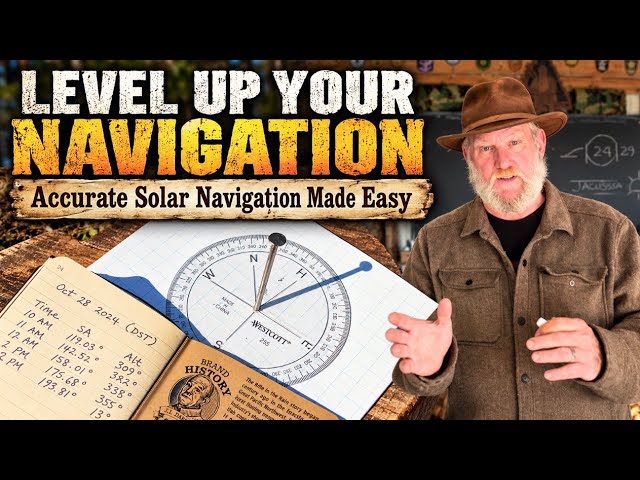
A 4-inch protractor costs approximately $3 and serves as the primary tool for marking degrees of orientation. A thin nail acts as the gnomon, providing the central point for casting a shadow onto the protractor’s surface. A notebook and pencil are required to record the pre-trip solar data needed to align the tool correctly.
What is a gnomon?
A gnomon is the vertical object used to cast a shadow for navigation. In this specific method, a thin nail serves as the gnomon, creating a clear point of reference for the shadow’s direction. A stable gnomon ensures that the resulting orientation remains consistent as the sun moves.
Optional gear like a circular slide rule can improve a long-term kit, but it is not required for the basic method. This setup provides a low-cost alternative to high-end GPS units from manufacturers like Garmin. Having these simple tools ensures you can navigate even if your electronics fail completely.
- GPS
- Must have sufficient battery life; provides high-precision location tracking when power is available.
- magnetic compass
- Must be kept away from local iron sources; allows for quick heading checks in non-magnetic environments.
- shadow stick
- Requires equal angles for accuracy; provides a simpler but less accurate way to find cardinal directions.
- Must be for the specific lat/long and date; eliminates calculation errors by providing pre-calculated data.
- pencil
- Required for writing down recorded solar angles.
- nail
- Should be thin for accuracy; creates the central point for casting the shadow.
- Prevents sun visibility; rendering the method impossible to use.
solar azimuth table
notebookProvides a place to record the pre-trip solar data.
cloud cover
Researching the solar azimuth is the most critical step in ensuring accurate orientation
Researching the solar azimuth for your destination is the most critical step in ensuring accurate orientation. You should use a search engine to find the “azimuth of the sun for every hour of the day” at your specific destination for your planned dates. Using the exact latitude and longitude of your campsite provides higher precision than using a general city name like Jackson, Ohio.
Recording the solar azimuth and calculating the reverse azimuth is the next step in your preparation. The reverse azimuth is the reciprocal direction used to determine where to rotate a protractor so that the 0-degree mark points North. Writing these numbers in a notebook before you depart ensures that you can orient your compass in just a few minutes once you are in the field.
Setting Up the Gnomon and Protractor
Positioning the gnomon is the first physical step in the field. You must secure a nail into a flat stump or surface to create a stable, vertical point for a shadow. A thin nail is preferred because a thinner gnomon provides a sharper, more accurate shadow for reading against the protractor.
Placing the 4-inch protractor at the base of the nail allows you to begin the orientation process. You must rotate the protractor until the shadow falls on the pre-recorded reverse azimuth from your notes. Once the shadow is aligned, the 0-degree mark on the protractor will face North. This process provides a reliable north-south-east-west reference line for your navigation.
How to Set Up Your Solar Navigation Device
- Identify your intended trip location and date.
- Search for the ‘azimuth of the sun for every hour of the day’ at that location for those dates.
- Record the solar azimuth and calculate the reverse azimuth for your desired times.
- Secure a nail (gnomon) into a flat stump or surface.
- Place a 4-inch protractor at the base of the nail.
- Rotate the protractor until the shadow falls on the pre-recorded reverse azimuth.
- Orient the protractor so the 0-degree mark faces North.
Troubleshooting and Common Failure Modes
Cloud cover is the primary obstacle to this method as it prevents sun visibility. If the sun is obscured, the method becomes impossible to use and you must rely on other tools. You should plan your navigation for clear-sky windows when the sun is visible.
Incorrect timing can lead to inaccurate orientation if the solar time is behind clock time. This happens because the sun’s position depends on the local apparent time at your specific longitude. Verify your watch time against the local time provided in your solar azimuth table to ensure the shadow is where you expect it to be.
Variations and Expected Results
The shadow stick method is a common predecessor that provides a simpler way to find cardinal directions. However, a shadow stick is often inaccurate because it requires perfectly equal angles on both sides of the sun’s zenith. Solar navigation provides a superior alternative by using pre-calculated data to account for the specific time and location.
Success is confirmed when the 0-degree mark of your protractor aligns with the actual North. You can verify this by checking your orientation against a secondary method or by observing the sun’s path over several hours. Accuracy improves as the gnomon becomes thinner and the pre-trip data becomes more precise.
When NOT to Use Solar Navigation
Solar navigation cannot be used during the night or during periods of heavy cloud cover. In these conditions, you should use a magnetic compass or a GPS device instead. These tools do not rely on the sun’s visibility and will provide a continuous orientation reference.
A hiker in Jackson, Ohio, simplifies solar orientation with pre-trip research
Suppose a hiker named Sarah is camping in Jackson, Ohio, on October 28th. Before leaving her home, Sarah looks up the solar azimuth for 2:00 PM and finds it is 13 degrees. She calculates the reverse azimuth for orientation and writes it in her notebook. In the field, she places a nail in a stump and her protractor at the base. She rotates the protractor until the shadow falls on the 13-degree mark. The 0-degree mark on her protractor now points exactly North.
If Sarah had skipped the pre-trip research and assumed a standard 15-degree shift, her orientation would be off by several degrees. By doing the work at home, she transformed a complex calculation into a simple five-minute task in the woods. This demonstrates how the accuracy of the method depends entirely on the quality of the data collected before the trip.
Still Unconfirmed
- The creator has not specified the exact degree of error margin for the thickness of the nail gnomon.
- The creator has not stated the specific brand of 4-inch protractor used for the demonstration.
Frequently Asked Questions
How much does the gear for solar navigation cost?
The gear for solar navigation is very low-cost because a standard 4-inch protractor can be found for about three dollars online. You only need to supplement this with a nail, a notebook, and a pencil.
Why is solar navigation better than a standard shadow stick?
Solar navigation is more accurate than a standard shadow stick because it is based on the true solar azimuth for your specific location and time. A shadow stick often yields wrong information if you do not have equal angles on both sides of the shadow.
What do I need to do before my trip to make this work?
To make solar navigation work, you must perform pre-trip research to find the azimuth of the sun for every hour of the day at your destination. Recording these values in a notebook ensures you can orient your protractor quickly once you arrive.
How do I find the sun’s azimuth for my location?
To find the sun’s azimuth for your location, you can enter your destination and date into a search engine. The results will provide a table of the sun’s horizontal position for every hour of the day.
Can I use a protractor to find north using the sun?
You can use a protractor to find north using the sun by aligning the device so the shadow falls on a pre-calculated reverse azimuth. This turns the simple tool into a high-precision solar compass for your journey.
Source: Solar Navigation Made Easy | Find Direction Using the Sun Accurately (David Canterbury).
Related articles
- How to Make a Wooden T-Handle for a Shovel
- Jim Brown Coffee Challenge: Mastering Bushcraft Fire-Starting
- How to set up a Rain Camping Setup for heavy rain
Related posts:
 Building a Hidden Cabin in a 7-ft Trailer
 Florida bushcraft packing: Everglades swamp survival gear
 Bushcraft Camp Comfort Gear: Building a Mobile Kitchen
 M1945 AGM Two-Burner Stove review: A durable military secret
 Knafs Little Lulu Review: A High-Performance Detail Knife
 How to set up a Rain Camping Setup for heavy rain
 Jim Brown Coffee Challenge: Mastering Bushcraft Fire-Starting
 How to Make a Wooden T-Handle for a Shovel