Florida bushcraft packing: Everglades swamp survival gear
Predicament Measures is reader-supported: some links on this page are affiliate links, and as an Amazon Associate Predicament Measures earns from qualifying purchases at no extra cost to you. Learn more.
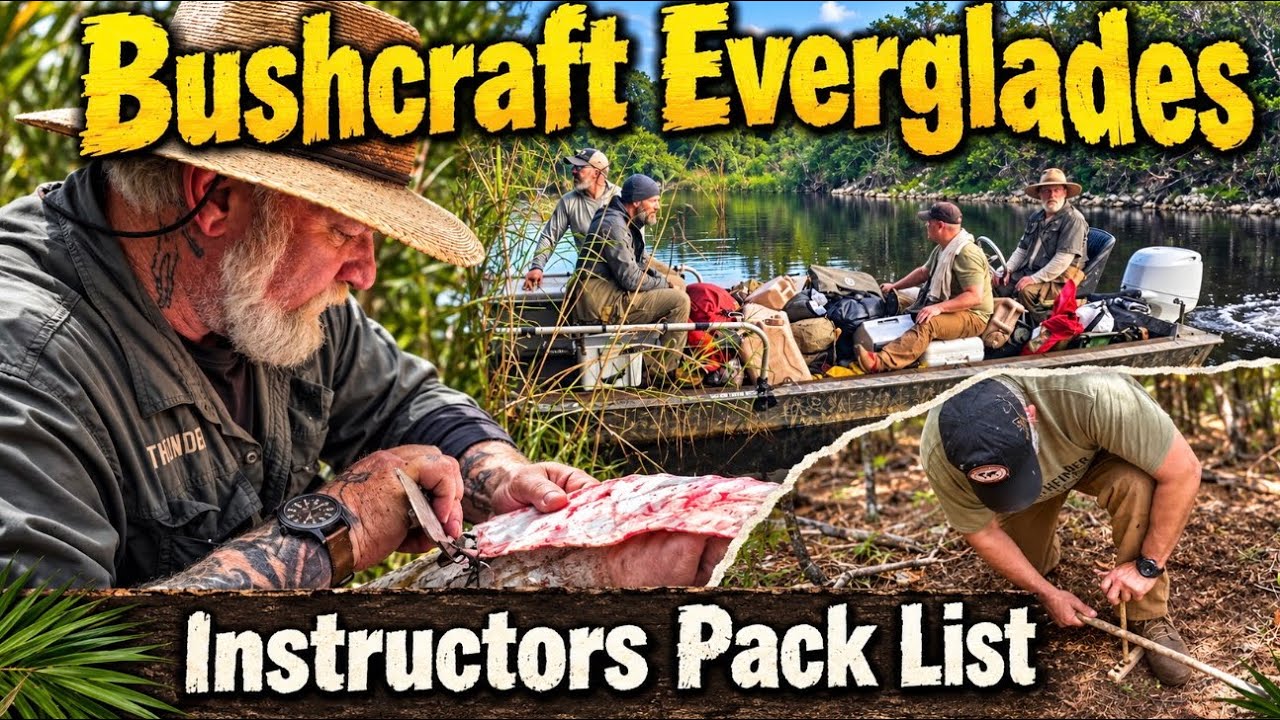
Dave Canterbury establishes that an Everglades bushcraft instructor pack relies on maritime logistics and specialized tools to navigate 9 km of subtropical wetlands. This strategy fails in environments where the lack of dense vegetation allows for the full swing arc of a traditional axe. Wilderness instructors and students of swamp bushcraft gear should act on this packing strategy.
Who should buy the Everglades bushcraft instructor pack and who should skip it
Readers who should act on the Everglades bushcraft instructor pack
- Bushcraft students in wet climates should study this list to understand how to manufacture tools like net needles and hooks from local materials.
- Wilderness instructors should use this as a blueprint for calculating water and gear volume for boat-based group transport.
- Overlanders and campers should adopt the use of extendable poles for setting up reliable tarps in tree-sparse swamp environments.
- Preppers building an emergency kit should use this breakdown to prioritize the “5 C’s” of survival in a practical, water-based context.
Readers who should skip the Everglades bushcraft instructor pack
- Medical professionals seeking first-aid procedures should skip this list and consult a certified wilderness first aid manual instead.
- Urban campers should skip this list and look at general car-camping gear guides that do not require boat logistics.
What to do next about the Everglades bushcraft instructor pack
- Replace a standard axe with a Silky Nata to split wood in tight spaces where a full swing is impossible.
- Pack 8 extendable Green Elephant poles to secure two 12×12 tarps in areas with sparse tree coverage.
- Bring a 100 watt solar panel to charge two Jackery Blazer power banks for remote communication.
- Include a Flex Cut carving jack in your kit to manufacture specialized tools like net needles off the landscape.
Most hikers currently carry standard hiking packs containing basic navigation and shelter items. This specialized wetland survival kit changes your approach by prioritizing manufacturing tools—like carving jacks and net needles—over heavy timber-processing tools like axes.
Logistical constraints of boat-based bushcraft
Boat transport dictates every equipment choice for the Florida Everglades because weight and space are the primary constraints. The transit to the camp is 9 km deep into the wetlands, and a fully loaded boat with an 80-horsepower motor takes roughly 30 to 40 minutes to travel in one direction. Because space is limited, instructors must trade off heavy items for high-utility tools.
Logistical planning requires a precise calculation of group needs versus available capacity. For a group of 12 to 18 people, an instructor might carry six 5-liter jerry cans of water. This provides 30 liters of water, which is enough for 7 people for one day. This means the instructor must plan for refills at the boat ramp or ensure students carry their own personal water containers.
The student pack: Tools for manufacturing
Students are expected to carry a specialized toolset designed to manufacture camp necessities off the landscape. The list includes a machete, a MOA Companion or similar 4 to 4.25 inch carbon steel knife, and a Flex Cut carving jack. The carving jack is a multi-tool that allows for the manufacture of concavities and other shapes that fit in a pocket. This focus on manufacturing allows students to create items like hooks and spoons during the 4-day class.
Fishing and net-making are core skills in this environment. Students carry a net needle that is 1/2 to 3/4 inch thick to begin practice with store-bought needles. During the course, they learn to create their own needle and gauge off the landscape to manufacture stop or gil nets. This bridge from modern tools to primitive skills is the heart of the bushcraft curriculum.
Instructor-level emergency and communication gear
The instructor carries high-level logistics and safety equipment that exceeds the requirements of a single student. This includes a full first aid kit with trauma supplies, an EpiPen, and an extra six life jackets for the boat. Communication is maintained via a 50 watt UHF/VHF radio equipped with a jungle antenna. This radio is tuned to the specific marine band frequency of a fire station located approximately 11 km from the camp.
Power and data for remote operations are managed through a 100 watt solar panel and two Jackery Blazer power banks. The instructor also carries a mobile Starlink for critical communication in the remote wilderness. These modern tools provide a safety net while students learn to improvise.
Water and shelter for subtropical environments
The Florida Everglades environment requires specific shelter configurations to handle consistent rain. The instructor provides two 12×12 tarps and 8 Green Elephant poles to accommodate a large group. These poles are extendable, ensuring a reliable shelter can be built regardless of specific tree placement. Because the area may have limited tree density, carrying poles is a smarter bet than relying on found timber.
Hydration strategies for the swamp rely on a multi-layered approach of filtration, boiling, and chemical disinfection. The kit includes a 6 L MSR expedition bag with a Sawyer filter, a quart of bleach, and a 6 L water bag. Additionally, the camp kitchen includes three 3-quart bush pots for boiling water in large quantities. This redundancy ensures that a group can survive even when the initial 30 liters of hauled water are depleted.
Navigational training aids and bridge to primitive skills
Navigation in a water-based wilderness requires a mix of modern technology and traditional maritime methods. The instructor utilizes a nautical almanac, a sextant, and star charts for celestial navigation. These tools are used to teach students how to convert coordinates from MGRS to lat/long. Why would a bushcraft instructor carry a nautical almanac and a sextant in a swamp? Because water-based navigation relies on celestial data that GPS alone may not provide in remote wetlands.
What is a Nautical Almanac?
A nautical almanac is a book of data for nautical navigation, including the positions of celestial bodies. It allows a navigator to determine their location by measuring the angle between a celestial object and the horizon. In a water-based wilderness, it serves as a primary data source for celestial navigation.
The curriculum emphasizes the “Modern-to-Primitive” bridge by teaching students how to replicate these functions using local materials. Students learn to improvise compasses, sextants, and water charts off the landscape. By understanding how the modern apparatus works, students can better judge which items are essential and which can be manufactured. Think of the Silky Nata as a surgical blade for wood-processing; it allows for precision in tight spaces where an axe’s swing arc is physically blocked.
Florida bushcraft packing vs standard hiking pack
A standard hiking pack and a swamp bushcraft gear kit share some similarities but differ significantly in their primary objectives. While a hiking pack prioritizes portable transport of pre-made supplies, the bushcraft kit prioritizes the tools needed to manufacture those supplies. The following table highlights the key differences in the tools carried for these two environments.
| Feature | Standard Hiking Pack | Florida Bushcraft Pack |
|---|---|---|
| Primary Tool | Folding Knife | Machete and Silky Nata |
| Wood Processing | Small Folding Saw | Silky Nata for tight spaces |
| Manufacturing | N/A | Flex Cut carving jack and net needles |
| Navigation | GPS / Compass | Sextant, Nautical Almanac, Starlink |
Survival logic in a boat-based scenario
Sarah is an outdoor educator planning a 4-day trip for 12 students into a swampy area accessible only by boat. She chooses two 12×12 tarps and 8 extendable poles to ensure everyone stays dry. She brings six 5-liter jerry cans of water to ensure they have a base supply for the first day before refilling. She selects a Silky Nata for her tool kit to handle wood processing in thick brush. Sarah successfully manages the weight on the boat while providing a safe, well-equipped learning environment. If Sarah had chosen a heavy axe and a single giant tarp, she might have exceeded the boat’s weight limit or been unable to find enough space to pitch a single large structure.
Everglades bushcraft instructor pack leaves these details unconfirmed
- Dave Canterbury has not specified the maintenance requirements for the Green Elephant poles.
- Dave Canterbury has not stated the legal regulations for carrying a Remington 870 in the Everglades.
Frequently Asked Questions
Why is a Silky Nata used instead of an axe?
The Silky Nata is used for wood splitting in areas that may be too tight to necessarily swing an axe. It allows for more precise wood processing in the dense vegetation of the Everglades.
How much water is provided for the group?
The instructor brings six 5-liter jerry cans, providing 30 liters of water. This amount is sufficient for 7 people for one day, requiring students to have personal water containers for the remainder of the 4-day course.
What navigation tools are used in the Everglades?
The navigation system includes a nautical almanac, a sextant, star charts, and a mobile Starlink. These tools allow for both celestial navigation and modern communication in a marine environment.
How do I make a net needle off the landscape?
The source indicates that students will learn to create a needle and gauge off the landscape during the class. Specific construction steps are not provided, but the focus is on manufacturing tools from local materials like bone or wood.
The ultimate value of this packing list is the shift from carrying results to carrying the means of production. By prioritizing tools like the carving jack and the Nata, you trade off the ability to process large timber for the ability to manufacture everything else you need to survive.
Reported from Everglades Bushcraft: What a Survival Instructor Packs | Dave Canterbury, published by David Canterbury.
Related articles
Related posts:
 Building a Hidden Cabin in a 7-ft Trailer
 Bushcraft Camp Comfort Gear: Building a Mobile Kitchen
 How to use a compass for 20 unconventional bushcraft skills
 M1945 AGM Two-Burner Stove review: A durable military secret
 Hidden Trailer Stealth Camper Performance and Design
 Mudslide Survival and Pre-Construction Planning
 OdenWolf Woods Knife Review: A Dedicated Bushcraft Tool
 FLISSA EDC Fixed Blade Knife review: a compact carving tool