How To – Raw Honey: Natural Antibacterial Wound Dressing for Burns and Lacerations
By Predicament Measures
Quick Answer: Can raw honey be used as an antibacterial wound dressing for burns and lacerations
Yes raw honey can be used as a topical antibacterial dressing for minor burns and lacerations because its high sugar concentration (osmolarity), low pH, hydrogen peroxide activity and nonperoxide components (notably in some honeys such as Manuka) inhibit many wound bacteria and support moist healing environments; however medicalgrade sterilized honey is preferred to reduce contamination risk.
- Effectiveness: In vitro bactericidal activity seen at concentrations often between 2-25 (v/v); clinical trials report faster healing for many partialthickness burns and superficial wounds, with variable results
- Cost: Raw foodgrade honey $5-20 per 250-500 g jar versus medicalgrade Manuka honey $20-80 per 100 g; antimicrobial commercial dressings typically $5-30 per dressing
- Time: Application 5-10 minutes; dressing changes commonly every 24-48 hours; superficial burns often heal in 7-14 days, partialthickness injuries typically 2-3 weeks depending on severity
- Limitation: Cannot replace surgical care for deep partialthickness or fullthickness burns, wounds with uncontrolled bleeding or deep contamination, or systemic antibiotics when infection is spreading or systemic; not a guaranteed sterilant against all pathogens
Raw honey is unprocessed bee honey containing naturally occurring sugars, low pH, enzymes and trace bioactive compounds. This $5-20 per 250-500 g jar solution is generally less expensive and more widely available compared to medicalgrade Manuka honey at $20-80 per 100 g, and can provide an accessible antibacterial, moist dressing option in firstaid and lowresource settings when used appropriately.
The process works through three key relationships: high sugar concentration (osmolarity) draws water from microbes resulting in measurable bactericidal activity often observed at 2-25 (v/v) in vitro, low pH inhibits bacterial growth enabling reduced colonization of the wound surface, and hydrogen peroxide activity plus nonperoxide components (e.g., methylglyoxal in some Manuka honeys) disrupt bacterial cells creating clinically observed benefits such as faster healing for many superficial burns and partialthickness wounds (variable by study).
How to use raw honey as a wound dressing step by step
- Assess the wound (2-5 minutes): Examine for depth, bleeding, and contamination. Instruction: If the wound is deep, gaping, has uncontrolled arterial bleeding, exposed bone/tendon, or signs of spreading infection (red streaks, fever), seek immediate surgical/medical care. Result: You determine suitability for topical honey (appropriate for minor superficial burns and clean, superficial lacerations).
- Clean the wound (5 minutes): Irrigate with clean water or sterile saline (use 200-500 mL for irrigation of a superficial wound) and gently remove visible debris with sterile gauze. Instruction: Pat dry with sterile dressing; do not scrub deeply. Result: Reduced gross contamination and a cleaner surface for honey application.
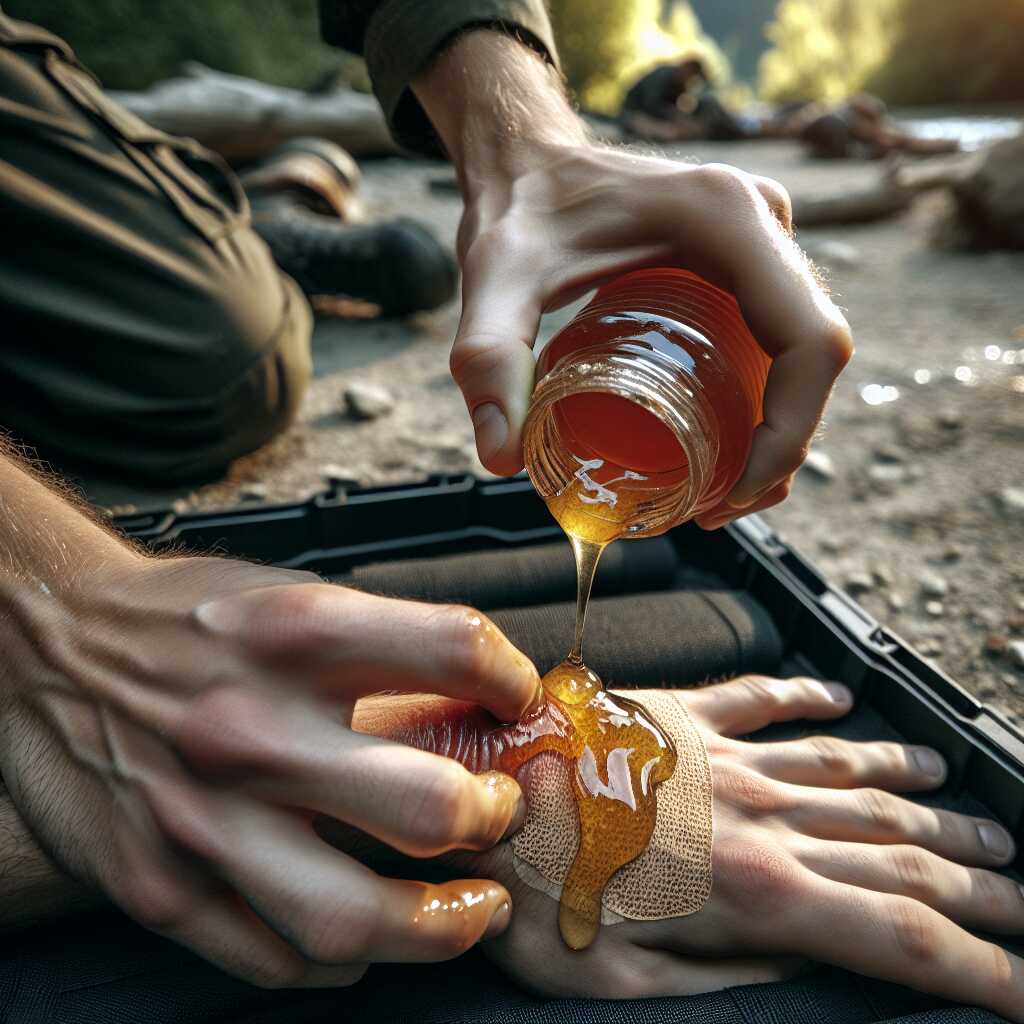
- Apply honey (5-10 minutes): Using clean gloves and sterile or very clean instruments, spread a 3-5 mm thick layer of raw honey directly over the wound surface (for a 2-5 cm diameter wound this typically uses 2-5 g). Instruction: Cover the wound completely and extend 1-2 cm onto surrounding intact skin. Result: Honey creates a moist, hyperosmotic antibacterial layer over the wound.
- Cover with a secondary dressing (2 minutes): Place sterile nonadherent dressing (e.g., sterile gauze or gauze impregnated with honey) over the honey, then a protective outer dressing or bandage to hold it in place. Instruction: Secure without excessive compression. Result: Keeps honey in contact with the wound and protects from external contamination.
- Change dressing regularly (10-20 minutes per change): Replace dressing every 24-48 hours for most superficial wounds; for heavily exuding wounds you may need to change every 12-24 hours. Instruction: At each change, reassess wound for increased pain, expanding redness, odor, increased drainage, or systemic symptoms. Result: Ongoing antimicrobial activity and monitoring for signs that further care is needed.
- Monitor healing and seek escalation (daily checks for 7-21 days): Expect reduced pain and gradual reepithelialization; superficial burns often show substantial healing by 7-14 days, partialthickness wounds by 2-3 weeks. Instruction: If no improvement in 48-72 hours, or if signs of spreading infection, increased necrosis, or systemic illness appear, stop topical-only treatment and obtain medical or surgical evaluation (may require debridement, systemic antibiotics, or specialized dressings). Result: Safe escalation when honey is insufficient and avoidance of delayed definitive care.
- Be aware of contraindications and precautions (immediate): Instruction: Do not use honey if the patient has a known allergy to honey or bee products; do not rely on honey alone for deeply penetrating wounds, crush injuries, uncontrolled hemorrhage, or suspected osteomyelitis. In infants under 1 year, avoid oral honey (botulism risk); consult a clinician about topical use. Result: Reduced risk of allergic reactions, delayed care, and inappropriate treatment choices.
FAQ
What is raw honey exactly and how is it defined medically
Raw honey is unprocessed bee honey that contains natural sugars, pollen, enzymes, and microbes and is not pasteurized or filter-sterilized for medical use. Medical descriptions treat raw honey as a food-grade product that can have antibacterial activity but variable composition and unknown sterility. Predicament Measures provides evidence summaries that state medical grade sterilized honey is preferred for wound care to reduce contamination risk and ensure consistent activity.
How does raw honey differ from medical grade Manuka honey
Raw honey differs from medical grade Manuka honey by having variable antibacterial components, unstandardized potency, and possible environmental contaminants. Medical grade Manuka honey is sterilized, tested for MGO or UMF levels, packaged in sterile 10-100 g units that cost about $20-80 per 100 g, and designed for reliable clinical use.
How does raw honey work step by step when used on wounds
Raw honey works by creating a high-sugar, low-pH, moist wound environment that draws fluid out of bacteria and damaged tissue, supplies osmotic antibacterial pressure, and helps epithelial cells migrate for wound closure. To apply, clean the wound with saline or clean water, spread a 2-5 mm thick layer of honey over the wound, cover with a sterile dressing, and change dressings every 24-48 hours with a 5-10 minute application time each change. Clinical practice notes show this method provides moisture, reduces odor, helps control local bacteria, and supports healing while testing and review guide ongoing use.
What antibacterial mechanisms in raw honey act on bacteria
Raw honey kills or inhibits bacteria through high osmolarity from 80-85 sugars, low pH around 3.2-4.5, hydrogen peroxide generation on dilution, and nonperoxide compounds in some honeys such as methylglyoxal in Manuka. Laboratory testing reports bactericidal activity at concentrations often between 2-25 (v/v) depending on honey type and organism and research reviews show these mechanisms work together to provide reliable local activity.
What are the main benefits of using raw honey on burns and cuts
The main benefits of using raw honey on minor burns and superficial lacerations include antimicrobial action, moist wound healing, reduced pain, and easy application that costs about $5-20 per 250-500 g jar for food-grade honey. Clinical reviews report faster healing for many partial-thickness burns and superficial wounds with variable results and superficial burns often heal in 7-14 days while partial-thickness injuries often heal in 2-3 weeks. Raw honey provides an affordable option in low-resource settings, enhances comfort, and helps reduce reliance on expensive commercial antimicrobial dressings that cost about $5-30 per dressing.
How much faster do burns and lacerations heal with raw honey
Clinical studies and reviews report faster healing times for many partial-thickness burns and superficial wounds, with some trials showing shorter time to closure compared with standard dressings. Reported healing ranges vary by study and wound depth, with superficial burns commonly healing in 7-14 days and many partial-thickness wounds improving within 2-3 weeks.
What are the risks and limitations of using raw honey on wounds
Raw honey carries risks including possible contamination with environmental microbes, inconsistent antibacterial potency, wound maceration if over-applied, and allergic contact dermatitis in sensitive people. Raw honey cannot replace surgical care for deep partial-thickness or full-thickness burns, wounds with uncontrolled bleeding, or wounds with deep contamination, and it is not a proven substitute for systemic antibiotics for spreading or systemic infection. Best practice testing and review recommend using medical grade sterilized honey when possible to reduce contamination risk and ensure consistent results.
When should you avoid using raw honey and seek medical care
Avoid raw honey and seek medical care for deep wounds, unstable or large burns, wounds with uncontrolled bleeding, signs of spreading infection such as fever or increasing redness, or suspected foreign bodies in the wound. Emergency care is essential for full-thickness burns, injuries requiring surgical debridement or sutures beyond simple closure, and any wound with signs of systemic illness because topical honey cannot handle these conditions.
Who should consider using raw honey for first aid on skin wounds
First aiders, outdoor enthusiasts, parents, caregivers, nurses, paramedics, low-resource clinicians, and disaster relief workers can consider raw honey for minor burns and superficial lacerations when medical-grade products are not available. People in low-resource settings can use food-grade raw honey that costs about $5-20 per 250-500 g jar to provide antimicrobial moisture while ensuring wound cleaning and regular dressing changes every 24-48 hours. Predicament Measures recommends training, testing, and review of local practice to ensure safe, reliable use and to guide when to escalate care.
Are there age conditions or allergies that rule out raw honey use
Do not give honey by mouth to infants under 12 months because of the risk of infant botulism; topical use on infants has limited testing and caution is advised. People with known honey or bee product allergies should avoid topical honey and seek alternative dressings, because allergic contact dermatitis or local reactions can occur and testing by an expert may help determine safety.
When is the best time to use raw honey after sustaining a burn
You should apply raw honey only after you cool and clean the burn, ideally within the first hour for minor superficial burns to help reduce bacterial growth and support moist healing environments. Cool the burn with running water for 20 minutes, remove rings or tight clothing, and gently pat dry before applying a thin honey layer of about 2-5 mm over the wound; this process takes about 5-10 minutes and often speeds comfort and healing in small burns. Raw honey provides antibacterial effects from high sugar osmolarity, low pH, and peroxide and nonperoxide activity, and medical grade sterilized honey is preferred to reduce contamination risk and improve reliability of results.
How soon should a wound be cleaned before applying raw honey dressing
Clean the wound immediately and thoroughly, using 0.9 saline or clean water to irrigate for 30-120 seconds until visible debris and loose material are removed, then dry gently before honey application. Use sterile gloves, single-use sterile gauze, and a sterile syringe or spatula to place about 1-5 mL of honey for a 55 cm wound, ensuring the wound is free of gross contamination and uncontrolled bleeding before applying honey.
How much does raw honey dressing cost compared to commercial dressings
Raw food-grade honey costs about $5-20 per 250-500 g jar while medical-grade Manuka honey sold for wound care ranges about $20-80 per 100 g and single-use antimicrobial commercial dressings cost about $5-30 each. A 250 g jar of raw honey can supply multiple small dressings, with each dressing using roughly 1-10 mL of honey so the per-dressing material cost can be under $1 for raw honey and $2-10 for medical-grade Manuka depending on concentration and pack size. Cost comparison reviews emphasize that raw honey offers a low-cost option in low-resource settings, while medical-grade honey or silver dressings provide tested, certified products that improve reliability and reduce contamination risk.
What is the price range for raw honey and for medical grade honey
Expect raw food-grade honey to sell for about $5-20 per 250-500 g jar and medical-grade Manuka or sterilized wound honey to sell for about $20-80 per 100 g depending on MGO/UMF rating and supplier. Medical grade products often come with testing data, sterility assurance, and packaging designed for wound use which adds to cost but provides useful quality control for clinicians and first aiders.
What materials and tools are needed to use raw honey as a dressing
You need basic sterile first aid supplies: 0.9 saline or clean water for irrigation (50-500 mL depending on wound), sterile gloves, sterile gauze or nonadhesive primary dressing sized to cover the wound by 2-3 cm, and a sterile 5-10 mL syringe or spatula to apply honey. Include secondary absorbent dressings and adhesive bandage or wrap to secure the dressing, and plan for dressing changes every 24-48 hours which takes about 5-10 minutes per change; pack spare dressings and single-use applicators to reduce contamination. Experience and testing show single-use application tools and sealed medical-grade honey deliver better safety and more reliable results than repeated dipping from a shared jar.
How should you prepare and store raw honey for safe wound use
Prefer medical-grade sterilized honey for wound use; if using raw food-grade honey in low-resource settings, use a clean unopened jar, draw honey with single-use sterile syringes, and discard any unused honey after a single dressing session to reduce contamination risk. Store honey at room temperature out of direct sunlight, inspect jars for fermentation, cloudiness, or mold, and do not heat honey for sterilization because heat can destroy active components that provide antibacterial action and wound-healing benefits.
What are the best alternatives to raw honey for wound care in emergencies
Best alternatives include sterile hydrogel or hydrocolloid dressings, silver-impregnated dressings, medical adhesive foam dressings, and topical antiseptics such as chlorhexidine or povidone-iodine when used appropriately and as directed. These alternatives provide proven antimicrobial action, moisture balance, and exudate control with products designed and tested for wound care settings, and clinical reviews show some dressings improve healing speed or reduce infection in specific wound types. Choose an alternative based on wound depth, amount of drainage, infection risk, and available supplies to ensure effective and safe care.
When should you choose silver dressings antiseptics or professional care instead
Choose silver-impregnated dressings or topical antiseptics when a wound shows heavy exudate, clinical signs of local infection (increasing redness, warmth, swelling, foul odor), rapid spreading cellulitis, or when the patient is immunocompromised; seek professional care immediately for deep partial-thickness or full-thickness burns, exposed tendon or bone, or uncontrolled bleeding. Use systemic antibiotics and surgical assessment when there are systemic infection signs such as fever, increased heart rate, or rapid wound deterioration, because topical honey cannot replace surgical debridement or systemic therapy for spreading or deep infections.
What common mistakes should be avoided when using raw honey on wounds
Do not apply raw honey to deep, heavily contaminated, or bleeding wounds and do not use honey as a substitute for surgery or systemic antibiotics when they are indicated, because those situations need professional care and interventions. Avoid double-dipping into a honey jar, leaving dressings unchanged for more than 48 hours, and using thick unventilated layers that cause skin maceration; these errors increase contamination risk, impede healing, and reduce the treatments reliability. Predicament Measures provides practical reviews and expert tips to help ensure safe, evidence-based use of honey in first aid and low-resource settings.
How can improper application or contamination make wounds worse
Improper application and contamination can trap bacteria, hide signs of infection, cause maceration of surrounding skin, and delay referral for needed surgical care or antibiotics, which can lead to larger wounds or systemic infection. Test the wound daily for increased pain, redness, swelling, foul odor, or fever and seek professional care within 24 hours if these signs appear, because early recognition and treatment improve outcomes and the efficiency of wound healing.
Related posts:
 Unwaxed Dental Floss: High-Strength Fishing Line Alternative for Wilderness Food Procurement
 Petroleum Jelly Cotton Balls: Five-Minute Burn Time Fire Starters for Damp Conditions
 Elastic Hair Ties: Cordage Bundle Organizers for Tangle-Free Emergency Kits
 Plastic Cling Wrap: Burn Wound Covering to Prevent Infection and Fluid Loss
 Used Coffee Grounds: Human Scent Masking for Wildlife Avoidance in Bear Country
 Maxi Pads: Large Absorbent Bandages for Major Trauma Wound Coverage
 Rubber Erasers: Emergency Ear Protection Against Dangerous Noise Levels
Acrylic Yarn: Emergency Wound Sutures for Gaping Lacerations
Rubber Erasers: Emergency Ear Protection Against Dangerous Noise Levels
Acrylic Yarn: Emergency Wound Sutures for Gaping Lacerations