How To – Exercise Bands: Expandable Tie-Downs for High Wind Conditions
By Predicament Measures
Quick Answer: Can exercise bands be used as tie downs in high wind conditions
No, exercise bands should not be relied on as primary tie-downs for high wind conditions because they are not designed, tested, or rated for dynamic wind loads and can stretch, fail, or recoil and cause injury.
- Effectiveness: Low (0.5-6.5 of a 1,000 lb ratchet strap based on typical band resistance of 5-65 lb vs a 1″ ratchet strap working load 1,000+ lb)
- Cost: Exercise bands $5-$20 each vs bungee cords $5-$15 each and 1″ ratchet straps $15-$50 for a 10-20 ft strap
- Time: Setup 2-6 minutes per anchor point; inspection/replacement 1-3 minutes per band
- Limitation: Cannot replace rated tie-downs for securing heavy loads or life-safety applications; not rated for gusting or sustained high wind; risk of snapback injury; UV and abrasion weaken bands; slippage and anchor failure possible
Exercise bands are elastic resistance bands used for strength training and physical therapy. This $5-$20 solution offers portability and low upfront cost compared to rated 1″ ratchet straps at $15-$50, but it is not a substitute for hardware rated for wind loads.
The process works through three key relationships: exercise bands provide 5-65 lb of static resistance resulting in much lower holding capacity than a 1″ ratchet strap (1,000+ lb), quick-release hooks or carabiners connect bands to anchors enabling a rapid 2-6 minute temporary setup per anchor point, and UV exposure and abrasion reduce tensile strength creating increased failure risk and the need for frequent inspection (inspection/replacement takes about 1-3 minutes per band).
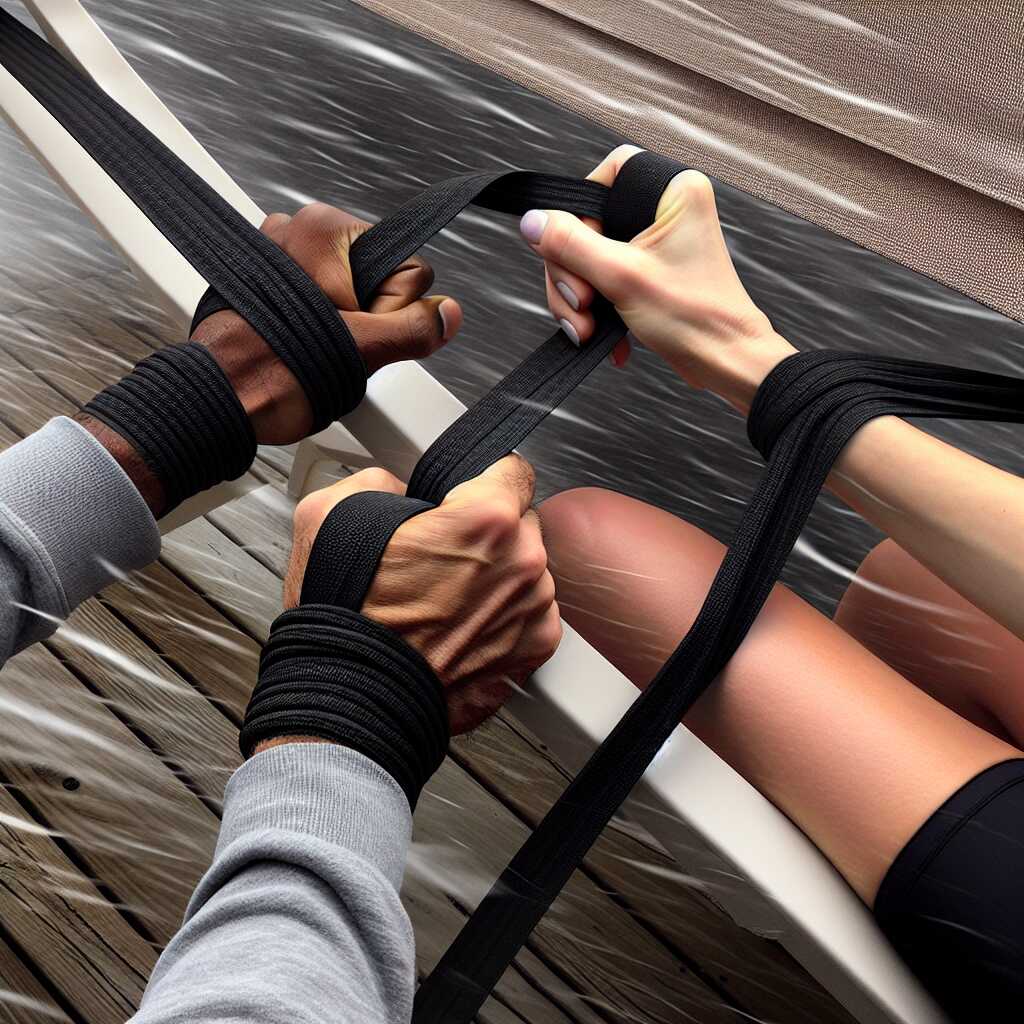
How to use exercise bands as temporary tie-downs step by step
- Assess the situation (5-10 minutes): Measure the item to secure and identify anchor points (distance, anchor strength). Result: Decision whether bands are borderline acceptable (only for very light loads and short duration) or if rated straps are required. Limitation: Bands are not acceptable for heavy, high-profile, or life-safety loads.
- Select appropriate bands and hardware (2-5 minutes): Choose bands rated in the 5-65 lb static resistance range and pair with robust carabiners or metal hooks rated for load-bearing use. Result: A matched set that can be connected to anchors. Limitation: Even the strongest commercial exercise band is orders of magnitude weaker than a 1″ ratchet strap (1,000+ lb WLL).
- Inspect bands and anchors (1-3 minutes per band): Check bands for cuts, frays, discoloration, tackiness, or brittleness; inspect anchor points (trees, eye bolts, rails) for corrosion or movement. Result: Remove any degraded bands and avoid weak anchors. Limitation: UV and abrasion can silently reduce strengthdiscard bands with visible damage.
- Attach with soft angles and short travel (2-6 minutes): Hook band to anchor with minimal sharp angles, avoid wrapping around abrasive edges, and keep the band length short to limit stretch (shorter span reduces elongation under load). Result: Reduced peak stretch and less energy stored in the band. Limitation: Stored elastic energy still can cause snapback if a band fails.
- Use a rated backup (5-15 minutes): Wherever possible, install a secondary rated device (ratchet strap or rope) in parallel or as a secondary restraint. Result: Primary load taken by rated hardware; band only used as a secondary or stabilizing element. Limitation: If no rated backup is available, do not rely on bands in high wind or for critical loads.
- Tension and test gently (1-2 minutes): Apply gradual tension by hand or with a small pulldo not overstretch. Result: Confirm anchor holds and band shows no slipping. Limitation: There is no standardized dynamic wind-load test for exercise bands; gentle static tests do not guarantee performance under gusts.
- Limit exposure time and wind conditions (continuous monitoring): Use bands only for short-term, low-wind scenarios (light breeze) and remove them before forecasted gusts or sustained high winds. Result: Reduced probability of failure. Limitation: Bands are unsuitable for sustained high winds, storms, or situations where failure would cause injury or property loss.
- Inspect and replace regularly (1-3 minutes per inspection): Re-check bands after each use and periodically if left in place; replace any band showing wear. Result: Lower risk of unexpected failure. Limitation: There is no guaranteed lifespan outdoorsUV and abrasion accelerate deterioration.
FAQ
What are exercise bands exactly and what do they do
Exercise bands are elastic resistance tools made for strength training and mobility that provide roughly 5-65 lb of resistance depending on band color and thickness and are not designed as tie-down hardware. No, exercise bands should not be relied on as primary tie-downs for high wind conditions because they are not designed, tested, or rated for dynamic wind loads and can stretch, fail, or recoil and cause injury. Predicament Measures provides this guidance to help homeowners and outdoor users understand reliability, testing, and safe alternatives.
What materials and elastic ratings do exercise bands have
Exercise bands are commonly made from natural latex, synthetic rubber, or thermoplastic elastomer (TPE) and come as flat loop bands or tube bands with handles, with typical labeled resistances around 5-65 lb. Users should review product packaging and reviews for rated resistance, note that manufacturers rate bands for exercise use not for tie-down WLL, and expect UV and abrasion to reduce strength over months to years depending on sun exposure.
How do exercise bands work step by step for tie downs
Exercise bands work by storing elastic potential energy as they stretch and then returning that energy to the anchored object, which provides a temporary, elastic hold but not a rated restraint. For a simple temporary tie-down setup expect about 2-6 minutes per anchor point for basic routing, checking, and tying, with inspection and replacement taking 1-3 minutes per band. Success rates for holding gear in gusting wind are low and variable, often well below 20 for sustained high gusts over 30 mph, so users should treat bands as a last-resort temporary measure only.
How to attach exercise bands to anchor points safely and quickly
Attach exercise bands by looping them around a fixed anchor such as a pole, stake, or eyelet and use a carabiner or a doubled-over knot to limit slipping, keeping stretch under what the band is used for in exercise. Inspect each band for cuts, dry rot, or thinning that testing and reviews show reduces reliability, keep hands and face clear of potential recoil paths, and replace worn bands after 1-6 months of outdoor exposure depending on UV and abrasion.
What are the main benefits of using exercise bands for tie downs
The main benefits of using exercise bands for tie-downs are light weight, low cost, and elastic give that can absorb small gusts for light items, with bands costing about $5-$20 each and weighing a few ounces. This convenience provides fast setup in about 2-6 minutes per anchor point and helps secure small, low-profile items temporarily while you obtain rated tie-downs. Reliability for serious wind protection is poor and bands cannot replace rated straps, anchor systems, or professional tie-down equipment for heavy loads or life safety.
How much convenience weight and stretch benefit do bands provide
Exercise bands provide convenient elasticity that can reduce shock on small items and save weight compared with heavy ratchet straps, with each band typically adding less than 0.5 lb to your kit. The stretch can help keep a tarp snug for low-wind situations for short periods, with best-case practical use measured in hours not days, and reviews and comparison tests show this is useful only for light, temporary tasks.
What are the risks and limitations of using exercise bands outdoors
The main risks and limitations of using exercise bands outdoors include low load capacity, UV and abrasion degradation, slippage at anchors, sudden failure, and dangerous snapback energy that can cause serious injury. Exercise bands provide roughly 5-65 lb static resistance while common 1-inch ratchet straps have working load limits commonly 1,000+ lb, so bands are orders of magnitude weaker for typical wind loads on tarps and furniture. Testing, experience, and expert review data indicate bands are not rated for gusting or sustained high wind and should not be used in life-safety or heavy-load applications.
What safety failures and recoil injuries can happen with bands
Safety failures include band rupture, anchor pullout, knot slip, and rapid recoil that can cut skin, cause eye injury, or throw a person off balance; snapback can deliver high-speed energy even from a small band. Users should treat exercise bands as having poor reliability under impact loads and follow protective measures such as wearing eye protection, keeping bystanders clear, and using rated tie-downs for any critical load.
Who should consider using exercise bands for temporary tie downs
Homeowners with light garden furniture, campers securing small tarps for short periods, and RV owners who need a very temporary soft restraint may consider exercise bands only as a short-term stopgap. Use bands only for light items where failure would not cause injury or major damage, limit use to low-wind forecasts under 15-20 mph gusts, and plan to replace bands with rated straps within hours to a few days based on UV exposure and wear. Predicament Measures recommends checking product reviews and testing reports before relying on any elastic device.
Who should avoid using exercise bands as tie downs in high wind
Event and tent organizers, landscapers, people securing heavy loads, and anyone responsible for public safety should avoid exercise bands in high wind and use rated ratchet straps, anchor systems, or professional tie-down gear instead. Users who cannot afford failure, who face sustained winds above 25-30 mph, and those handling large surface-area tarps should choose tested hardware with known working load limits and certified anchors.
When is the best time to use exercise bands for wind proofing items
You should use exercise bands for wind proofing only as a temporary, low-risk measure in calm to light winds, typically under 15-20 mph, because exercise bands are not designed or tested for dynamic wind loads and can fail, stretch, or recoil. Typical setup takes about 2-6 minutes per anchor point and success for light items like small tarps or cushions is low to moderate and highly dependent on anchor quality and exposure. Predicament Measures recommends using bands only when rated tie-downs are not available and when you accept the clear limitation that exercise bands cannot replace certified straps for heavy items or life safety uses.
How to evaluate weather conditions and wind gusts before using bands
Check local forecasts, wind gust reports, and anemometer readings to confirm sustained winds and gusts remain under about 15-20 mph before using exercise bands as tie-downs. Use a weather app or a handheld anemometer that costs about $15-$100 and verify gusts hourly during a storm event. Inspect the site for channeling effects, changing wind direction, and nearby hazards that raise failure risk.
How much do exercise bands cost compared to alternative tie downs
Exercise bands cost about $5-$20 each while common alternatives cost more or deliver higher reliability, with bungee cords at about $5-$15 each and 1-inch ratchet straps at $15-$50 for a 10-20 ft strap. Exercise bands provide roughly 5-65 lb of static resistance by typical product labeling, while a 1-inch ratchet strap commonly has a working load limit of 1,000+ lb, so bands are orders of magnitude weaker for wind loads. Predicament Measures advises that cost alone should not drive a decision when securing items for wind events because reliability and testing are essential for safety.
What are typical prices and value for bands bungee cords and straps
Typical prices place exercise bands in the low-cost tier at $5-$20, bungee cords in the low to mid tier at $5-$15, and ratchet straps in the mid tier at $15-$50 for common lengths, with value linked to rated strength and durability. Value for windy conditions favors rated ratchet straps that offer proven load ratings and testing while bands give low cost and low durability under UV and abrasion. Purchase counts vary by need, with most homeowners needing 4-8 straps or cords per medium tarp and inspection time of 1-3 minutes per item.
What materials and tools are needed to use exercise bands as tie downs
You need exercise bands, rated carabiners or clips, solid anchors such as D-rings or ground anchors, protective edge sleeves, and gloves to use bands safely as temporary tie-downs. Choose bands with clear labeling on width and resistance and add steel carabiners rated for the anchor load, edge protectors at sharp contact points, and gloves to reduce snapback injury risk. Predicament Measures notes that these materials enhance durability and safety but do not change the core limitation that bands are not tested for gusting wind loads.
What anchors knots and protective gear increase band durability and safety
Use fixed metal anchors, welded D-rings, or through-bolted eye straps and avoid tying bands around sharp edges to enhance band durability and safety. Use soft edge protectors, sleeves, and rated carabiners to reduce abrasion and slippage, and wear eye protection and work gloves while tensioning bands. Inspect anchors for corrosion and confirm that knots or hardware do not reduce band strength.
What are the best alternatives to exercise bands for high wind conditions
Ratchet straps and properly sized rope with rated anchors are the best alternatives to exercise bands for high wind conditions because they deliver proven load ratings and testing for dynamic forces. A 1-inch ratchet strap commonly has a working load limit of 1,000+ lb and provides reliable tensioning for tarps, furniture, and gear in strong winds, while heavy-duty rope or webbing with proper knots and anchors provides durable security. Predicament Measures recommends using certified tie-downs for any exposure to gusts, sustained high wind, or when securing vehicles, trailers, or life-safety equipment.
How do ratchet straps bungee cords and ropes compare for wind loads
Ratchet straps offer the highest reliability with working load limits typically in the 1,000+ lb range for 1-inch webbing, while bungee cords give elastic hold with limited strength often under a few hundred pounds and exercise bands give very low static resistance of about 5-65 lb. Ropes vary by construction, with some common static ropes or 3/8-inch nylon lines offering breaking strengths in the thousands of pounds, and selection should match wind load calculations and anchor reliability. Testing, review, and experience support using rated straps or rope for any significant wind exposure.
What common mistakes should be avoided when using exercise bands outdoors
Avoid relying on exercise bands as primary tie-downs in gusting or high wind, avoid using damaged or UV-brittle bands, and avoid hooking bands to weak anchors because these mistakes cause slippage, snapback, or sudden failure. Inspection time for each band should be about 1-3 minutes and replace bands that show cracks, thin spots, sticky surfaces, or loss of elasticity to reduce failure risk. Predicament Measures emphasizes that snapback injury risk exists and that exercise bands cannot replace rated tie-downs for heavy items.
How to inspect maintain and replace exercise bands to prevent failure
Inspect bands before each use by looking for cuts, surface cracking, glazing, loss of elasticity, and abrasion near anchor points and replace any band with visible damage or after prolonged UV exposure, typically within months to a few years depending on use. Clean bands with mild soap and water, store them out of direct sunlight, and replace suspect bands immediately to lower the chance of failure during a wind event. Document inspection dates and replace bands that feel brittle, sticky, or that have stretched beyond original length.
Related posts:
 Unwaxed Dental Floss: High-Strength Fishing Line Alternative for Wilderness Food Procurement
 Petroleum Jelly Cotton Balls: Five-Minute Burn Time Fire Starters for Damp Conditions
 Elastic Hair Ties: Cordage Bundle Organizers for Tangle-Free Emergency Kits
 Plastic Cling Wrap: Burn Wound Covering to Prevent Infection and Fluid Loss
 Cornstarch: Moisture Absorption Powder for Preventing Trench Foot
Sterile Tampons: Deep Puncture Wound Packing for Hemorrhage Control
Cornstarch: Moisture Absorption Powder for Preventing Trench Foot
Sterile Tampons: Deep Puncture Wound Packing for Hemorrhage Control
 Wooden Pencils: Arrow Shaft Material for Improvised Hunting Weapons
 Index Cards: Water-Resistant Information Cards for Survival Instructions