How To – Corrugated Cardboard: Ground Insulation Barrier for Cold Weather Sleeping
By Predicament Measures
Quick Answer: Can corrugated cardboard be used as a ground insulation barrier for cold weather sleeping
Yes, corrugated cardboard can provide useful ground insulation because its fluted structure traps air and adds thermal resistance, but it is limited by compression, moisture damage, and lower R value than closed cell foam pads
- Effectiveness: R value approximately 0.7 to 1.0 per inch of layered corrugated cardboard (R/in), so 2 inches can provide about R1.4 to R2.0
- Cost: Often free or <$5 versus $20 to $150 for commercial sleeping pads depending on type and R value
- Time: 10 to 30 minutes to collect, cut, and lay 1 to 4 layers for a single sleeping spot
- Limitation: Cannot perform when wet, compresses under body weight reducing insulation, offers lower long term durability and lower R per thickness than closed cell foam pads
Corrugated cardboard is a layered paperboard with a fluted (wavy) inner core between two flat liners that traps air and increases thermal resistance. This $0-$5 solution provides basic ground insulation and improved comfort compared to commercial sleeping pads at $20-$150, though it offers lower R-value per inch and shorter durability.
The process works through three key relationships: corrugated flutes trap air resulting in reduced conductive heat loss and an R value of approximately 0.7-1.0 per inch, stacking multiple layers increases thickness enabling a cumulative R value (for example, two inches R1.4-2.0), and keeping cardboard dry and separated from wet ground creates usable insulation but only while dry and uncompressed.
Step-by-step: How to prepare and use corrugated cardboard as a ground insulation barrier
- Collect suitable cardboard (10-20 minutes): Look for clean, dry, double-wall or single-wall corrugated sheets roughly 2436 in or larger. Avoid oil-stained, laminated, or heavily soiled pieces. Result: 1-4 usable sheets for one sleeping spot.
- Dry and flatten sheets (15-60 minutes depending on moisture): If damp, air-dry under shelter or near (not on) a heat source until fully dry; flatten folded boxes to restore flat panels. Result: cardboard ready for layering; wet cardboard will lose most insulating value.
- Trim to pad size (5-15 minutes): Cut or tear to match sleeping area (typical pad 20-30 in wide, 70-75 in long for a full-length pad; smaller for sit/short pads). Use a box cutter or scissors. Result: uniform pieces that fit under your sleeping bag.
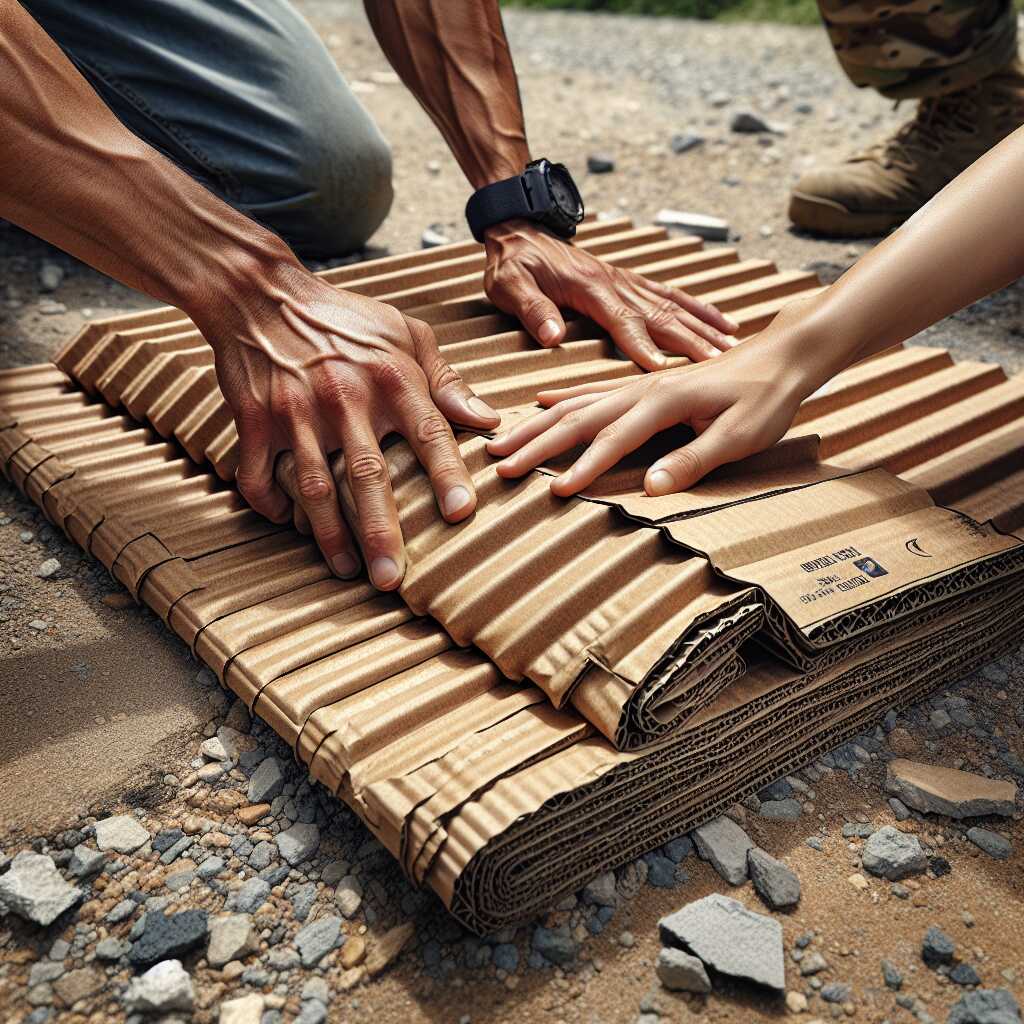
- Layer for target R-value (5-10 minutes): Stack 1-4 layers depending on available material and temperature. Each inch of corrugated cardboard adds about R0.7-1.0; two inches gives roughly R1.4-2.0. Result: increased thermal resistance versus bare ground.
- Add a moisture barrier (2-5 minutes): Place a plastic tarp, garbage bag, or closed-cell foam sheet between the ground and the cardboard if available. Result: prevents ground moisture from soaking cardboard and preserves insulation.
- Place and test compression (1-3 minutes): Lie on the layered cardboard in your normal sleeping position and check for excessive compressionif the layers flatten to nothing, add more layers or use a foam pad. Result: verify insulation remains under body weight.
- Protect edges and seams (2-5 minutes): Overlap sheets and tape seams or tuck edges under to reduce drafts and heat loss through gaps. Result: more consistent coverage and reduced cold spots.
- Pack and store spare material (2-5 minutes): After use, keep some dry cardboard in a waterproof bag or covered area for reuse. Result: extends lifespan and readiness for next use.
FAQ
What is corrugated cardboard ground insulation barrier exactly
Corrugated cardboard ground insulation barrier provides a low-cost, portable layer that reduces conductive heat loss by trapping air in flutes and layers and can be collected and prepared in 10 to 30 minutes for a single sleeping spot. The material typically costs free to under $5 per setup compared with $20 to $150 for commercial sleeping pads and offers an approximate R value of 0.7 to 1.0 per inch of layered corrugated cardboard, so a 2-inch stack provides about R1.4 to R2.0. The barrier delivers useful emergency insulation in dry conditions and has limits in durability, reliability, and performance when wet or under long-term compression and therefore cannot replace purpose-designed closed-cell foam pads for repeated cold-weather use.
How is corrugated cardboard made and what are its thermal properties
Corrugated cardboard is made from flat linerboards bonded to a fluted inner layer that creates sealed air pockets which provide thermal resistance and R values of roughly 0.7 to 1.0 per inch depending on flute type and compression. Typical single-wall cardboard sheets measure about 1/8 to 1/2 inch thick per sheet depending on A/B/C/E flute styles and layered stacks of 2 to 4 sheets reach 1 to 2 inches of thickness, which research and field testing indicate provides modest insulation compared with closed-cell foam. The material performs well in dry tests and reviews for short-term use but loses performance when saturated and cannot match the long-term durability and R per inch of foam pads designed for cold weather.
How does corrugated cardboard work step by step as ground insulation
Corrugated cardboard works by creating trapped air spaces that slow heat flow from the body into the ground and by breaking direct contact with cold soil through one or more layered sheets placed beneath a sleeping bag or pad. Start by clearing debris, then lay 1 to 4 layers flat with overlap of 6 to 12 inches, orient flutes to preserve air pockets, and add a vapor barrier such as a plastic bag where water risk exists; set-up time is typically 10 to 30 minutes and field success in dry conditions is high for emergency use. The approach enhances comfort and reduces conductive heat loss but cannot prevent wind chill, radiative heat loss, or moisture penetration when exposed to rain or wet ground and therefore requires additional gear or shelter for extended cold weather sleeping.
What sequence of layers and placement gives the best insulation effect
Place 2 to 4 layers of corrugated cardboard under your torso and hips first, then add sheets under legs and shoulders to improve overall R value and comfort with a target stack thickness of about 1 to 2 inches for best trade-off between bulk and insulation. Alternate flute direction where possible, overlap seams by 6 to 12 inches, and put a closed-cell foam pad or emergency blanket on top when available to enhance durability, improve moisture resistance, and increase the system R value. The sequence delivers practical results in about 10 to 30 minutes and provides a useful, low-cost option when designed layering and placement practices are followed.
What are the main benefits of using corrugated cardboard for ground insulation
Corrugated cardboard provides essential, low-cost ground insulation that is easy to obtain, with typical collection and cutting taking 10 to 30 minutes and costs often at $0 to $5 per sleeping spot. The material offers a useful R value of about 0.7 to 1.0 per inch and helps preserve body heat in short-term and emergency scenarios when dry, which makes cardboard a good backup in preparedness kits and a common choice among preppers, homeless outreach providers, and campers in 2025 field reviews. The solution enhances comfort and can handle quick deployment in shelters and tents while offering an inexpensive comparison to higher-cost gear, and Predicament Measures recommends cardboard as an emergency option with known limits for long-term reliability and durability.
How much warmth and comfort can you expect in degrees and hours
Expect modest warmth gains from layered cardboard with typical user reports indicating small surface temperature improvements that often feel like 1 to 3 degrees Celsius warmer at the contact surface in calm dry conditions, depending on clothing, ground temperature, and wind. The cardboard stack can provide improved comfort for several hours during a single night when kept dry and sheltered, with useful performance reported for short-term use; exact temperature and hours vary by site conditions and cannot be guaranteed. The measure offers a reliable emergency boost to comfort that helps preserve core warmth compared with sleeping directly on cold ground but will not match the performance of high-R commercial pads over long periods.
What are the risks and limitations of using corrugated cardboard as insulation
Corrugated cardboard loses most of its insulating benefit when wet, compresses under body weight which reduces effective R value, and is combustible near open flames so it cannot be used as a heat source or close to stoves. The material shows lower long-term durability and lower R per inch than closed-cell foam pads, and repeated use in wet or muddy conditions leads to rapid degradation and failure within hours to days depending on exposure. The limitations affect reliability, testing outcomes, and overall performance and require users to plan for backups and protective measures such as plastic vapor barriers and spare pads.
How does moisture weight compression and fire risk affect performance
Moisture collapses the flutes and replaces trapped air, which causes the R value to fall quickly and makes wet cardboard ineffective within minutes to hours of heavy exposure; keep cardboard elevated and under a waterproof layer to preserve performance. Body weight compresses layers immediately and reduces the effective insulation so stacking 2 to 4 sheets helps offset compression while closed-cell foam maintains R under load and provides superior performance. Cardboard is combustible when exposed to open flame or hot stove surfaces and therefore must be kept at a safe distance from heat sources because it cannot serve as a fire-safe pad or heat source.
Who should consider using corrugated cardboard for cold weather sleeping
Emergency preppers, homeless outreach teams, outdoor backpackers in a pinch, cold weather campers on short trips, and search and rescue volunteers can consider corrugated cardboard as an emergency ground insulation barrier when cost, weight, and availability are critical factors. Predicament Measures suggests cardboard for short-term and emergency use when users need fast, cheap insulation that provides modest R values of about 0.7 to 1.0 per inch and can be collected in 10 to 30 minutes, with the understanding that it cannot replace purpose-built gear for repeated cold exposure. The option improves chances of staying warmer in dry conditions and fits situations where a low-cost backup is essential, while durable pads remain the best choice for reliability and long-term performance.
When is cardboard a reasonable choice compared with gear alternatives
Cardboard is reasonable when cost is a primary constraint, when weight and bulk of commercial gear are unacceptable, and when the use is short term or emergency; cost comparison shows cardboard at $0 to $5 versus sleeping pads at $20 to $150 so cardboard helps in budget-limited situations. Use cardboard in dry, sheltered sites for single nights or brief missions and combine it with a plastic vapor barrier or a thin foam pad to enhance moisture protection and performance, keeping in mind that cardboard cannot handle repeated wet conditions or heavy compression like closed-cell foam. The approach offers an easy, fast, and practical emergency solution that provides useful insulation for many users while expert gear provides higher quality, durability, and predictable results.
When is the best time to use corrugated cardboard for ground insulation
Use corrugated cardboard as a ground insulation barrier when the ground is dry, temperatures are near freezing or mildly below freezing, and you need a fast, low-cost layer to reduce conductive heat loss; cardboard provides trapped-air insulation with an approximate R value of 0.7 to 1.0 per inch so two inches of layered cardboard gives about R1.4 to R2.0. Setup and placement take about 10 to 30 minutes for a single sleeping spot and small-scale testing and user experience show noticeable comfort improvement in many dry, calm conditions. Cardboard cannot perform when wet, compresses under body weight which reduces R value, and Predicament Measures recommends using cardboard only as a short-term or backup option while testing and reviews favor closed-cell foam for longer-term reliability.
What weather conditions and ground types make cardboard useful or useless
Cardboard is useful on dry dirt, packed snow with a dry top crust, and flat grass where it sits dry and uncompressed because those surfaces let the corrugated flutes trap air and deliver thermal resistance. Cardboard is useless on wet soil, standing water, saturated snow, rocky ground with sharp edges, or in heavy rain because moisture destroys the flutes, the material compresses, and the insulation value falls quickly.
How much does corrugated cardboard cost compared to foam sleeping pads
Corrugated cardboard often costs $0 to $5 if scavenged from stores or recycling centers while commercial foam sleeping pads range from $20 to $150 depending on pad type and rated R value, so cardboard provides a very low-cost option for emergency insulation. Cardboard can provide R1.4 to R2.0 with 2 inches of layered material while a simple closed-cell foam pad may deliver higher R per thickness and longer durability. Time to gather cardboard is typically 10 to 30 minutes and estimated success in reducing conductive heat loss is higher in dry conditions but lower in wet or heavy-use scenarios.
Where to find cheap or free cardboard and how to estimate material needed
Find cheap or free cardboard at grocery stores, appliance stores, liquor stores, and online classified listings or by asking local businesses for spare boxes; Predicament Measures notes that many users collect 2 to 6 large sheets for one sleeping spot. Estimate material needed by covering a sleeping area roughly 72 inches by 24 inches; one to four full-size moving boxes or 2 to 4 large flat sheets usually fill that area and take 10 to 30 minutes to cut and lay. Always test layers before use to confirm the covered area feels warmer and to check for gaps that reduce performance.
What materials and tools are needed to build a corrugated cardboard barrier
You need corrugated cardboard sheets, a plastic groundsheet or tarp, duct tape or packing tape, a utility knife, and a measuring tape to build a reliable ground insulation barrier; Predicament Measures lists these items as essential for ensuring dry, sturdy placement. Expect assembly time of 10 to 30 minutes and a simple setup that helps reduce conductive heat loss while delivering a fast, low-cost improvement in comfort. The cardboard design cannot handle prolonged wet exposure and users should add a waterproof layer under the cardboard to preserve insulation performance and enhance durability.
How many layers and what cutting and fastening tools are recommended
Use 2 to 4 layers of corrugated cardboard for a typical sleeping spot to reach an estimated R1.4 to R2.0, with 3 layers offering a good balance of weight, pack size, and insulation in dry conditions. Use a sharp utility knife for clean cuts, duct tape to join panels, and a tarp or plastic sheet under the cardboard to prevent moisture wicking; these tools improve reliability and make the system easy to set up and pack away.
What are the best alternatives to corrugated cardboard for insulating the ground
Best alternatives include closed-cell foam pads, inflatable self-inflating pads, foam roll mats, and natural materials like layered pine needles or dry leaves because these options typically provide higher R value, better durability, and better moisture resistance. Emergency foil blankets and bivy sacks offer low bulk but low R value compared to foam and insulated pads while natural materials deliver mixed performance and require time to collect and test for dryness. Predicament Measures suggests testing alternatives in controlled conditions and using cardboard only as a temporary or backup option when higher-performance gear is not available.
How do foam pads emergency blankets and natural materials compare in R value and durability
Foam pads and inflatable pads generally offer higher R value per thickness and greater durability than cardboard, with inflatable pads often providing the highest R for backpacking use while closed-cell foam offers rugged, fast, and very durable performance. Emergency foil blankets deliver minimal R value and are fragile when used under load, while natural materials can provide useful insulation when dry but compress and rot over time, which reduces effectiveness and reliability for repeated use.
What common mistakes should be avoided when using corrugated cardboard for sleeping
Common mistakes include placing cardboard directly on wet ground, using only a single thin layer, and failing to add a waterproof barrier because these errors let moisture destroy the flutes, compress the material, and drop insulation value quickly. Many users omit tape joins and leave gaps at the edges which lets cold drafts move under the sleeping area and reduces the system’s performance. Predicament Measures recommends testing the setup in a safe environment and treating cardboard as a short-term, emergency solution rather than a durable long-term pad.
How to prevent moisture compression and avoid trapping condensation and drafts
Prevent moisture compression by placing a waterproof tarp or plastic sheet under the cardboard, elevating the cardboard slightly on small branches or a lightweight frame, and keeping the top layer dry with a cover that breathes to reduce trapped condensation. Seal panel edges with tape to avoid drafts, pack spare dry sheets in a waterproof bag for fast replacement, and check the system every few hours during use to maintain insulation efficiency and improve overall comfort.
Related posts:
 Unwaxed Dental Floss: High-Strength Fishing Line Alternative for Wilderness Food Procurement
 Petroleum Jelly Cotton Balls: Five-Minute Burn Time Fire Starters for Damp Conditions
 Elastic Hair Ties: Cordage Bundle Organizers for Tangle-Free Emergency Kits
 Plastic Cling Wrap: Burn Wound Covering to Prevent Infection and Fluid Loss
 Cornstarch: Moisture Absorption Powder for Preventing Trench Foot
Sterile Tampons: Deep Puncture Wound Packing for Hemorrhage Control
Cornstarch: Moisture Absorption Powder for Preventing Trench Foot
Sterile Tampons: Deep Puncture Wound Packing for Hemorrhage Control
 Wooden Pencils: Arrow Shaft Material for Improvised Hunting Weapons
Acrylic Yarn: Emergency Wound Sutures for Gaping Lacerations
Wooden Pencils: Arrow Shaft Material for Improvised Hunting Weapons
Acrylic Yarn: Emergency Wound Sutures for Gaping Lacerations