How To – Vine Charcoal: Water Filtration Media When Crushed and Layered
By Predicament Measures
Quick Answer: Can crushed vine charcoal filter and purify water
No, vine charcoal can improve clarity, taste and remove some particulates and organic odors but it cannot reliably purify water because it is not activated carbon and does not remove pathogens or many dissolved contaminants
- Effectiveness: Turbidity reduction 50-90; adsorption of some organics 10-60
- Cost: Low if you source vine prunings yourself ($0-$5 per kg) vs commercial activated carbon ($10-$30 per kg)
- Time: Making charcoal: 2-6 hours pyrolysis + 12-24 hours cooling; processing 15-60 minutes; building filter 10-30 minutes; adsorption effectiveness increases with 10-60 minutes contact time
- Limitation: Cannot reliably remove bacteria, viruses, dissolved salts, nitrates, or many heavy metals not a certified water purifier
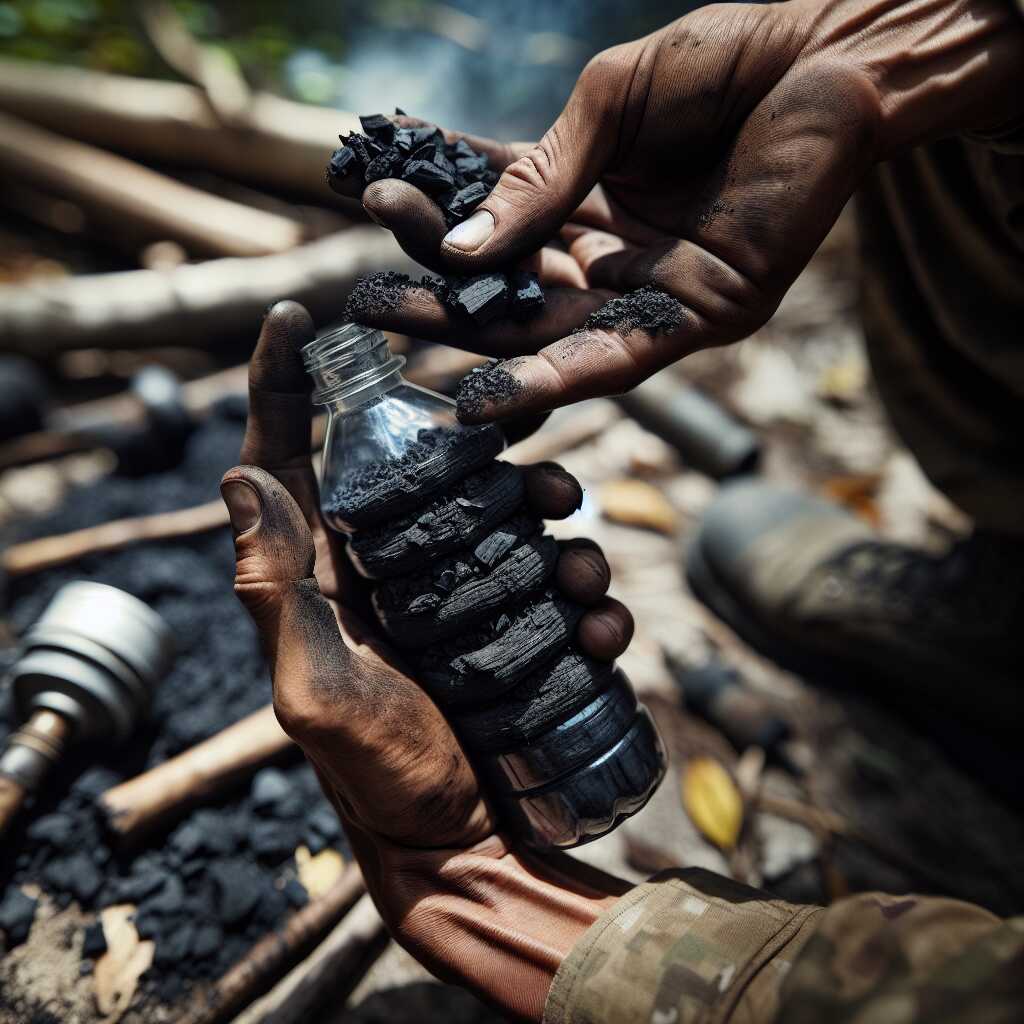
Vine charcoal is charcoal produced by pyrolyzing grapevine or similar vine prunings; it is a porous, unactivated charcoal material with limited adsorption capacity compared to commercial activated carbon. This $0-$5 per kg solution can improve visible clarity and reduce some tastes and odors at much lower cost compared to commercial activated carbon at about $10-$30 per kg.
The process works through three key relationships: crushed vine charcoal adsorbs organic compounds resulting in measurable reductions in taste and odor (roughly 10-60 for various compounds), layered charcoal with sand and gravel traps and settles particulates enabling substantial turbidity improvement (approximately 50-90 visible turbidity reduction in DIY designs), and increased contact time increases adsorption capacity creating higher removal rates (longer contact can push removal toward the upper end of those ranges for some contaminants).
How to make a DIY vine-charcoal water filter step by step
- Make vine charcoal (2-6 hours pyrolysis + 12-24 hours cooling): Build a small pit or metal retort, heat vine prunings in a low-oxygen environment until they char (2-6 hr depending on load and method). Allow the char to cool undisturbed 12-24 hours. Instruction: use dry vine wood, monitor to minimize open flames, and quench only after fully cooling. Result: solid charcoal pieces suitable for crushing; yield typically 20-30 by mass of the original wood.
- Crush and sieve to target particle size (15-60 minutes): Crush cooled charcoal with a mallet or hammer and sieve to produce granules in the 0.5-5 mm range for packed filters (finer granules increase surface area but raise clogging risk). Instruction: wear a dust mask and gloves, crush on a tarp, then rinse under running water until the rinse runs clearer. Result: cleaned crushed charcoal with reduced fines and dust, ready for layering.
- Prepare filter container and base layers (10-20 minutes): Choose a container: a 2 L PET bottle for personal use or a 5gallon (18.9 L) bucket for batch filtering. Instruction: add a bottom cloth or coffee filter to prevent charcoal loss, then layer coarse gravel (10-30 mm) 3-5 cm, coarse sand 5-10 cm. For a 2 L bottle use 50-150 g crushed charcoal; for a 5gallon bucket use 500-1500 g crushed charcoal depending on desired charcoal layer thickness. Result: a stable base that pre-filters large particles and supports the charcoal layer.
- Add the charcoal layer and top sand (5-10 minutes): Instruction: add the crushed vine charcoal layer 5-10 cm thick (adjust by container size), then cover with a thin sand layer (1-2 cm) to prevent surface disturbance. Result: a layered filter with a charcoal adsorption zone and mechanical pre- and post-filtration.
- Pre-condition (flush) the filter (10-30 minutes): Instruction: slowly run clean potable water through the filter until effluent is visibly clear and no more charcoal dust appears (may require several liters). Result: reduced initial turbidity from fines and a stabilized flow rate; expect some initial loss of small particles.
- Filter raw water (per batch: 5-60 minutes depending on volume and desired contact time): Instruction: pour or feed turbid water and allow gravity flow. For improved adsorption, hold filtered water in contact with charcoal (e.g., pass water slowly or use a small holding chamber) for at least 10-60 minutes; slower flow increases adsorption. Result: visible turbidity reduction commonly in the 50-90 range and partial reduction of some tastes/odors (10-60), but little to no reliable pathogen removal.
- Post-treatment for microbiological safety (10-30+ minutes): Instruction: treat filtered water with a proven disinfectant: boil the effluent at a rolling boil for 1 minute (increase to 3 minutes above 2,000 m altitude) or use a certified UV device or EPAapproved chemical disinfectant per label instructions. Result: killed or inactivated bacteria, viruses, and protozoa when properly treated. Important: do not rely on vine charcoal alone for microbiological safety.
- Maintenance and replacement (monitor continuously; replace charcoal every 1-3 months depending on use): Instruction: monitor flow rate and effluent clarity; if flow slows markedly or taste returns, replace the charcoal layer. For continuous use, plan to replace crushed vine charcoal after filtering 50-200 L per kg of charcoal depending on water quality, or sooner if performance degrades. Result: maintained performance and reduced risk of biological growth in the media.
- Costs and materials checklist (10-30 minutes to gather): Instruction: expect material costs roughlycharcoal (if sourced: $0-$5/kg), container (2 L bottle free-$2; 5gallon bucket $3-$10), sand/gravel $0-$10, basic tools $0-$15. Result: a low-cost DIY filtration setup suitable for improving clarity and taste in emergency contexts but not a substitute for certified purification.
FAQ
what is vine charcoal and how is it defined for filtration
Vine charcoal is charcoal made from pruned grapevines or similar woody vine cuttings and is defined for filtration as unactivated carbon used in layered DIY filters that can trap coarse particles and adsorb some organic compounds. Making vine charcoal requires low-oxygen heating that typically takes 2 to 6 hours plus 12 to 24 hours cooling and can yield roughly 0.6 to 0.9 kg of charcoal per 1 kg of dry vine wood, which is useful data for cost and supply planning. Predicament Measures recommends testing and review of any batch because reliability, testing, and comparison with commercial activated carbon determine what contaminants the media can handle and what it cannot remove.
what types of vine charcoal are best for water filtering
Hard, dense vine charcoal that is evenly carbonized and free of ash and glue from bark provides the best physical filtration and more consistent adsorption in a filter bed. You should choose pieces that crush to 1-5 mm granules after sieving and that show no visible tar or heavy ash to improve efficiency and ease of use.
how does crushed vine charcoal remove particles and chemicals
Crushed vine charcoal removes particles by mechanical straining and removes some chemicals by surface adsorption on micro-pores, with performance that depends on grain size, surface area, and contact time. A layered filter that includes gravel, coarse sand, fine sand, and 1-5 mm crushed charcoal can reduce visible turbidity by about 50 to 90 in field trials and can adsorb some organic tastes and odors at roughly 10 to 60 effectiveness depending on the compound and contact time. Users should run basic testing and comparison with known standards because vine charcoal does not provide certified removal of pathogens, dissolved salts, nitrates, or many heavy metals.
how long should water contact crushed charcoal to adsorb organics
Water should contact crushed charcoal for at least 10 minutes to 60 minutes to increase adsorption of some organic tastes and smells, with longer contact time improving results for low-concentration compounds. Real-world test data vary and require testing for your source water because contact time, charcoal grain size, and contaminant type determine results and reliability.
what are the main benefits of using vine charcoal for water
Vine charcoal benefits include low cost, local availability, and the ability to improve clarity and reduce some organic tastes and odors in DIY filters, which helps survivalists and homesteaders in emergency or backcountry use. Cost can be near $0 to $5 per kg when you source vine prunings yourself versus $10 to $30 per kg for commercial activated carbon, and building a layered filter typically takes 10 to 30 minutes with crushing and sieving in 15 to 60 minutes. Field reviews and simple tests show useful improvements for non-microbial contaminants and visible clarity, but users must note limits and not treat charcoal as a complete purifier.
how much improvement in taste and clarity can I expect
Expect a noticeable reduction in cloudiness and some improvement in taste in many cases, with turbidity reductions commonly in the 50 to 90 range when charcoal is paired with sand and gravel in a layered assembly. Taste results are variable, ranging from about 10 to 60 removal for some organics, and you should plan simple testing like visual comparison, odor checks, and small sample boiling to judge performance.
what are the risks and limitations of crushed vine charcoal filters
The main risks and limitations are that crushed vine charcoal is not activated carbon, it cannot reliably remove bacteria, viruses, protozoa, dissolved salts, nitrates, or many heavy metals, and it is not a certified water purifier. Pathogen removal from charcoal alone is negligible for safety planning and requires complementary steps such as boiling for 1 minute (3 minutes above 2,000 m elevation), chemical disinfection, UV disinfection, or certified membrane filtration to ensure microbiological safety. Users must conduct testing, use expert review where possible, and understand that field data and lab testing determine real-world reliability and safety.
how dangerous are bacteria and viruses that charcoal cannot remove
Bacteria and viruses can cause serious illness and charcoal cannot reliably reduce their risk, so relying on charcoal alone leaves water unsafe for drinking after exposure to fecal contamination or wildlife. You should always pair charcoal filtration with proven disinfection methods or certified filters because testing, review, and expert guidance show that unactivated charcoal does not meet microbiological safety standards.
who should consider using crushed vine charcoal for emergency water
People who should consider crushed vine charcoal include survivalists, backcountry campers, homesteaders, preppers, and DIY makers who need a low-cost, locally sourced media to improve clarity and taste when other treatment is unavailable. Users who choose vine charcoal should have basic skills in making charcoal (2-6 hours carbonizing plus 12-24 hours cooling), crushing and sieving to 1-5 mm, assembling layered filters in 10-30 minutes, and performing simple field tests to confirm performance and safety.
what skills and precautions should a user have before using it
Users should know safe pyrolysis methods, wear protective gloves and eye protection while crushing, perform simple turbidity and taste tests, and plan complementary disinfection such as boiling or chemical treatment to ensure microbiological safety. Predicament Measures recommends practice, testing, and review of filter batches and that users track time, charcoal grain size, and flow rate to improve efficiency and repeatable results.
when is the best time to use crushed vine charcoal water filters
The best time to use crushed vine charcoal filters is in short-term emergencies or backcountry situations when you need to improve water clarity and taste but cannot access certified purification gear, with expected turbidity reduction in layered DIY designs roughly 50 to 90 depending on flow and layers. Making usable vine charcoal by small-scale pyrolysis takes about 2 to 6 hours plus 12 to 24 hours cooling, crushing and washing take 15 to 60 minutes, and building a layered filter takes 10 to 30 minutes, so this method suits planned prep or multi-hour emergency setups. This option provides low cost (about $0 to $5 per kg if you use vine prunings), delivers improved clarity and odor control, and does not reliably remove bacteria, viruses, dissolved salts, nitrates, or many heavy metals so treat its reliability and testing requirements as limited.
how does season storage and moisture affect stored charcoal effectiveness
Stored vine charcoal loses adsorption effectiveness when it becomes wet or exposed to oily or odorous air, and you should store charcoal dry in sealed containers at relative humidity under 20 when possible to retain performance for months to years. If charcoal absorbs moisture its pore space fills and efficiency drops, so dry any wet charcoal by air drying for 24 to 72 hours or low heat before use and perform simple tests for taste and turbidity to confirm usefulness.
how much does crushed vine charcoal filtration cost compared to alternatives
Crushed vine charcoal filtration costs are low when you source materials yourself, around $0 to $5 per kilogram for DIY vine charcoal, while commercial granular activated carbon runs about $10 to $30 per kilogram for consumer grades and prepacked cartridges commonly cost $5 to $40 each. Alternative systems show different cost profiles: ceramic filters range from $30 to $150 for household units, UV portable units range from $50 to $300, and certified membrane filters and pump systems often exceed $100, so compare initial cost, replacement cost, and expected service life when you evaluate options. Predicament Measures recommends weighing cost against required removal performance because vine charcoal delivers low to moderate adsorption for organics and particulate control but cannot replace microbiological disinfection or certified filtration in reliability and testing.
what are typical prices for commercial activated carbon and DIY charcoal
Typical prices as of 2025 for consumer activated carbon are roughly $10 to $30 per kilogram and for preassembled filter cartridges $5 to $40 each depending on brand and quality, while DIY vine charcoal made from prunings can cost near $0 to $5 per kilogram after basic processing. Expect to spend $20 to $100 on small-scale charcoal kilns or metal drums for repeated production, and plan for additional costs such as sieves, cloth, and containers that add $10 to $50 for a simple DIY build.
what materials and tools are needed to build a crushed vine charcoal filter
You need vine charcoal crushed to chosen granularity, cleaned river sand, graded gravel, food-safe containers or buckets, fine mesh cloth for support, and tools such as a hammer, metal sieve (1 mm to 5 mm), gloves, and eye protection to build a layered DIY filter. For a 10 to 20 liter portable column expect to use 0.5 to 2 kg crushed charcoal, 2 to 5 kg sand, and 1 to 3 kg gravel with flow outlet fittings and a simple stand to support 10 to 60 minutes of contact time for basic adsorption. Follow safety guidance, wear a dust mask when crushing, rinse fines until runoff clears, and document testing and review of filter performance for reliability and experience data before relying on the system.
what grain sizes and layer thicknesses should you use for best results
Use gravel of 10 to 20 mm for the bottom support layer, coarse sand of 0.5 to 2 mm above the gravel, crushed vine charcoal of about 0.5 to 4 mm in the active layer, and a 2 to 5 mm fine sand or cloth cap to prevent fines, with a suggested layer thickness in a 20 to 30 cm column of 5 cm gravel, 5 cm coarse sand, 8 to 12 cm charcoal, and 2 to 5 cm fine sand or cloth. Design for contact time between 10 and 60 minutes depending on contaminant load, expect turbidity removal commonly in the 50 to 90 range for visible particles, and keep in mind that pathogen removal is negligible so combine with boiling, chemical disinfection, UV, or certified membrane filtration for microbiological safety.
what are the best alternatives to crushed vine charcoal for water treatment
The best alternatives for reliable water treatment are certified membrane filters, ceramic candle filters, UV disinfection units, and commercial activated carbon used in conjunction with disinfecting methods, because these options provide proven removal of microbes or specific chemical targets that vine charcoal cannot consistently handle. Ceramic filters typically trap protozoa and bacteria down to 0.2 to 0.5 micron pore sizes and commonly remove over 99 of those organisms by physical exclusion, UV systems can inactivate bacteria and viruses with documented high log reductions when water is clear, and activated carbon cartridges deliver strong adsorption for chlorine and many organic compounds while requiring periodic replacement. Choose alternatives based on testing, reviews, reliability, cost, and the contaminants you need to address, and note that even good systems need maintenance, testing, and correct installation to deliver expected performance.
how do ceramic pumps UV and activated carbon compare in removal and cost
Ceramic filters cost about $30 to $150, remove most bacteria and protozoa through physical filtration, and need regular cleaning of the candle surface to maintain flow and effectiveness. UV pocket units range $50 to $300, provide fast disinfection for bacteria and viruses when water turbidity is low, and require bulb replacement roughly every 9 to 12 months, while activated carbon media costs $10 to $30 per kg and excels at removing taste, odor, and some organic chemicals but does not reliably remove microbes without added disinfection steps.
what common mistakes should be avoided when using crushed vine charcoal
Common mistakes include assuming crushed vine charcoal purifies microbiological hazards, using unwashed charcoal with high dust and ash content, packing charcoal too fine so flow clogs and contact time drops, and failing to pair charcoal with boiling or chemical treatment for bacteria and viruses. Replace charcoal when flow rate drops by about 50 or when taste, odor, or turbidity returns, expect useful service life for a small DIY filter from days to a few weeks depending on water quality and usage, and always perform simple testing for turbidity and microbial contamination before relying on the filter for drinking water. Predicament Measures emphasizes testing, review of results, and conservative use of DIY charcoal filters only as a clarity and taste enhancer, not as a sole purifier.
how to properly clean replace and test a DIY charcoal filter for safety
Rinse new crushed charcoal with 5 to 20 liters of clean water until the runoff is clear, assemble layers in a clean container, and pre-filter cloudy water through cloth or a settle-and-decant step to reduce clogging and extend service life. Test filter performance with a portable turbidity meter, at-home bacterial test strips, or lab testing when possible, replace charcoal media when flow slows by 50 or when testing shows bacterial presence after treatment, and always follow up with boiling, chemical disinfection, or UV to ensure microbiological safety if you plan to drink the water.
Related posts:
 Unwaxed Dental Floss: High-Strength Fishing Line Alternative for Wilderness Food Procurement
 Petroleum Jelly Cotton Balls: Five-Minute Burn Time Fire Starters for Damp Conditions
 Elastic Hair Ties: Cordage Bundle Organizers for Tangle-Free Emergency Kits
 Plastic Cling Wrap: Burn Wound Covering to Prevent Infection and Fluid Loss
 Cornstarch: Moisture Absorption Powder for Preventing Trench Foot
Sterile Tampons: Deep Puncture Wound Packing for Hemorrhage Control
Cornstarch: Moisture Absorption Powder for Preventing Trench Foot
Sterile Tampons: Deep Puncture Wound Packing for Hemorrhage Control
 Wooden Pencils: Arrow Shaft Material for Improvised Hunting Weapons
 Index Cards: Water-Resistant Information Cards for Survival Instructions