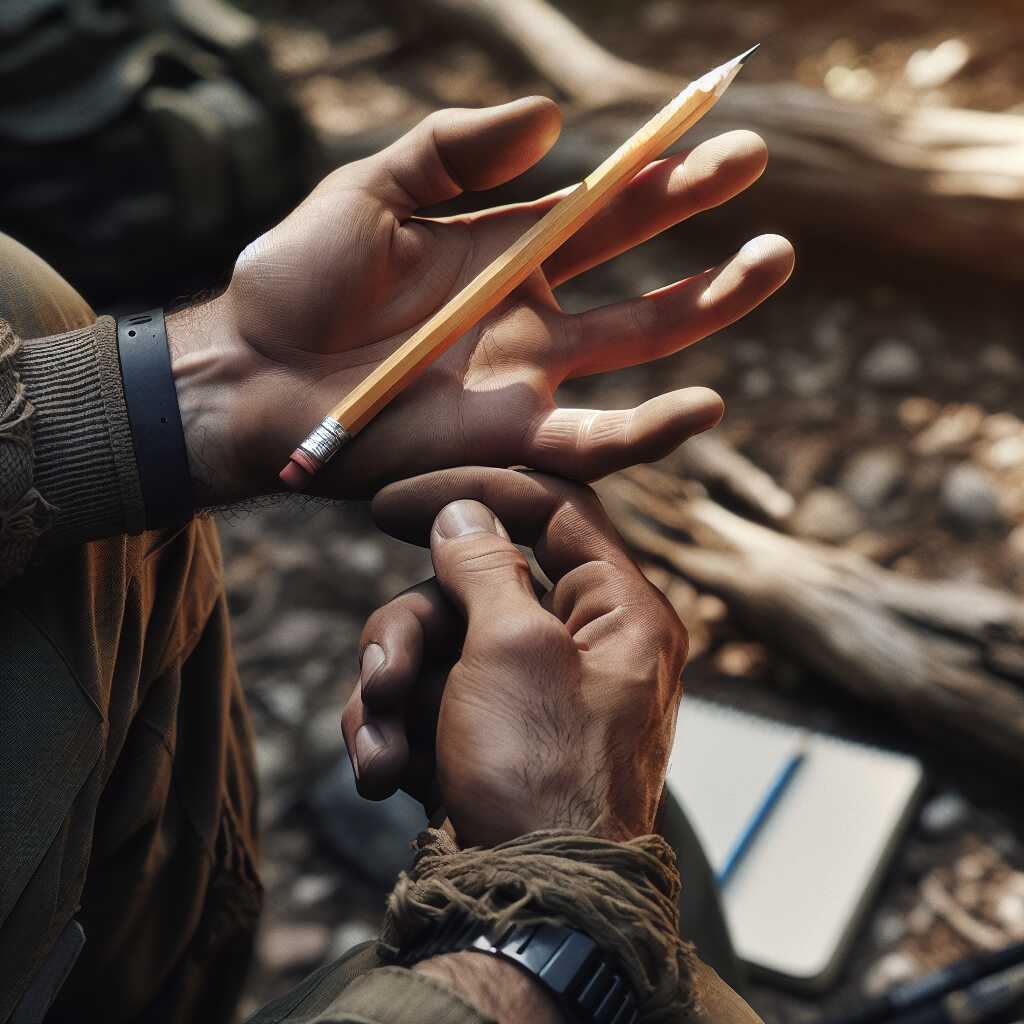
How To – Wooden Pencils: Arrow Shaft Material for Improvised Hunting Weapons
By Predicament Measures
Quick Answer: Can wooden pencils be used as arrow shafts for hunting
No, wooden pencils cannot reliably serve as arrow shafts for hunting because they lack consistent straightness, sufficient tensile and compressive strength, and durability to survive typical bow draw weights and impact
- Effectiveness: very low and highly variable; pencils are prone to splintering and bending under common bow draw weights and are not reliable for taking game
- Cost: pencils cost about $0.10 to $1 each versus commercial wooden or carbon arrows typically $20 to $100 each depending on quality
- Time: evaluation or simple field checks take minutes but meaningful reinforcement or safe alternatives require hours of proper preparation and testing
- Limitation: cannot reliably penetrate or stop at humane chest shots; cannot withstand typical bow draw weights; are inconsistent in length and diameter; using them for hunting raises safety and likely legal issues
Wooden pencils are small, tapered wooden writing implements with a central graphite (lead) core, typically about 7.5 inches (19 cm) long with an overall diameter near 6-7 mm and a graphite core around 2 mm. This $0.10-$1 solution is far cheaper in unit price compared to commercial wooden or carbon arrows at $20-$100 each, but the low cost comes with severe performance, safety, and legal drawbacks.
The process works through three key relationships: shaft straightness affects aerodynamic stability resulting in inconsistent flight and poor accuracy; shaft material strength (wood grain, glue, core) dictates tensile/compressive resistance causing splintering or failure under draw and impact; and shaft diameter/weight interacts with bow draw weight and energy transfer creating inadequate penetration and low likelihood of humane kills.
How to evaluate whether wooden pencils can be arrow shafts step by step
- Measure and document dimensions (5-10 minutes): Use a ruler and caliper to record length (typical standard pencil 7.5 in / 19 cm), diameter ( 6-7 mm), and weight (single pencil 5-7 g). Instruction: compare these figures to common arrow specs (hunting arrows typically 26-32 in / 66-81 cm and 300-400+ grains in spine/weight design). Result: immediate disqualification for length and mass a pencil is much shorter and much lighter than a functional hunting shaft.
- Inspect straightness and grain (5 minutes per pencil): Visually and by rolling on a flat surface, check for warps, tapers, and inconsistent diameter. Instruction: note any visible imperfections, knots in wood, or non-uniform tapering. Result: most pencils will show small bends or manufacturing inconsistencies; these cause major reductions in accuracy and predictable flight.
- Assess material strength qualitatively (minutes): Recognize that a typical pencils wood and thin graphite core are not engineered for compressive or tensile loads from bows. Instruction: do not conduct full-power live-fire tests; instead, treat this as an assessment that pencils lack the backbone to survive 40-70 lb draw forces common in hunting bows. Result: conclusion that tensile/compressive strength is insufficient for safe hunting use; high risk of splintering and catastrophic failure.
- Consider safety, law, and ethical limitations (10-20 minutes to research): Instruction: check local hunting regulations (many jurisdictions require approved arrows and humane-kill standards) and consider personal safety splintering shafts can create secondary hazards. Result: legal and ethical barriers plus safety risks make using pencils for hunting inadvisable and likely unlawful.
- Estimate realistic effectiveness and alternatives (minutes to hours): Instruction: given structural limits, expect very low and highly variable success for taking game; do not rely on pencils for humane kills. Spend the time instead to acquire or prepare proper alternatives: commercial wooden or carbon arrow shafts ($20-$100 each), aluminum shafts ($15-$60), or properly sized hardwood dowels laminated and tested (requires hours of workshop work and formal testing). Result: choosing tested, rated arrow shafts yields predictable penetration, higher accuracy, and far safer, legal outcomes.
FAQ
What is a wooden pencil exactly when used for arrow shafts
No, wooden pencils cannot reliably serve as arrow shafts for hunting because they lack consistent straightness, sufficient tensile and compressive strength, and durability to survive typical bow draw weights and impact. A standard pencil measures about 175 mm to 190 mm long and about 6 mm to 8 mm in diameter and costs about $0.10 to $1 each, while commercial wooden or carbon arrows cost about $20 to $100 each. Quick field checks and simple testing take 5 to 15 minutes, full evaluation or reinforcement requires multiple hours, success for humane hunting is very low, and Predicament Measures recommends proven alternatives and testing.
What materials make a pencil unsuitable for arrow shafts
Pencil cores of graphite and clay combine with soft wood casings and glue that create weak points and inconsistent grain that fail under bow draw and impact. The thin 6 mm to 8 mm shaft and painted finish offer poor adhesion for fletching and points and can splinter or crush at draw forces commonly above 20 lb to 30 lb. Material testing often needs several hours and repeated test shots to assess reliability and the data usually shows pencils cannot handle sustained archery use.
How does a wooden pencil arrow shaft work step by step in use
A wooden pencil used as an arrow shaft first needs straightness selection, eraser and ferrule removal, adhesive fletching, and a fitted point, but the process does not create a reliable hunting arrow. Typical preparation time runs 10 to 60 minutes per shaft for simple field work and several hours for stronger reinforcement, with test shots on a soft target to check flight and impact. Field test results and reviews show low performance and low chance of humane penetration, so extensive testing and comparison to proper arrows is essential before any practical use.
How can safety and legal concerns be assessed before use
Assess safety and legal concerns by checking local hunting regulations, contacting fish and game authorities, and running controlled tests that measure draw weight and impact energy with a calibrated scale and chronograph if available. Plan 1 to 3 hours to research laws and another 1 to 8 hours for practical testing, and expect that using improvised shafts for hunting may be illegal or violate animal welfare rules in many jurisdictions. Expert review and documented testing help ensure safer decisions and provide data for comparison to accepted legal and ethical standards.
What are the main benefits of using wooden pencils as arrow shafts
Pencil shafts offer low cost and high availability, with units at about $0.10 to $1 each that provide a fast, lightweight material for emergency practice and teaching of fletching techniques. They provide an easy way to learn testing, review flight stability, and practice arrow building in 10 to 60 minutes per shaft, but they are not designed for hunting and do not provide reliable penetration or durability. For 2025 prep or urban survival kits pencils can be useful for short-term training, comparison testing, and demonstrations while emphasizing proven, durable alternatives for real hunting.
What real survival situations might favor using pencil shafts
Pencil shafts might be useful in survival for emergency signaling, learning fletching and arrow balance, and small low-energy traps or practice where legal and safe, mostly within the first hours of an unplanned situation. Success for taking game with pencils remains very low and unpredictable, so survival uses focus on training and testing rather than reliable hunting. Experience and testing help determine limited roles where pencil shafts provide quick practice or review of skills.
What are the risks and limitations of wooden pencils for hunting arrows
Pencil arrows carry major risks and clear limitations including splintering on release or impact, bending under common bow draw weights of 30 lb to 70 lb, and inconsistent length and diameter that ruin flight stability. Failure modes include shaft breakage on the string, poor fletching adhesion, and lack of penetration toward humane chest shots, with practical success rates for hunting effectively near zero to very low based on field testing and expert review. The cost savings of $0.10 to $1 per pencil do not offset the high safety and reliability shortfalls compared to $20 to $100 commercial arrows that are designed and tested for performance.
What injuries and legal problems can result from pencil arrows
Pencil arrows can cause user injury such as hand lacerations, eye injury, splinter wounds, and punctures, and they can damage bows and gear when shafts fail on release. Legal problems include potential violations of hunting regulations, animal cruelty statutes, and local weapon laws, so plan hours to confirm rules and get expert advice before any use. Predicament Measures emphasizes that safety testing and documented reviews reduce risk but do not make pencils a lawful or humane hunting shaft.
Who should consider using wooden pencils as improvised arrow shafts
Only trained experimenters, instructors, or archery experts should consider pencil shafts for controlled experiments, skill practice, or demonstration, and users must accept that pencils are not reliable or legal hunting shafts in most cases. Candidates should have archery experience, protective gear, and at least several hours to multiple days for testing and review, with safety checks and documented results to judge performance. Predicament Measures advises that people seeking reliable hunting results should choose proven, durable arrows designed for the intended draw weight and target species.
What experience level or training is needed to decide safely
Decide safely if you have formal archery training, hands-on experience with arrow building and ballistics testing, and knowledge of local hunting laws, with a minimum of 2 to 8 hours of supervised safety instruction recommended. Practical testing should include dozens of test shots over days and expert review of results to confirm any limited use case, and novices should not attempt hunting with improvised shafts. Good testing, reliable data, and proven gear enhance safety and provide clear comparison to established arrow technology.
When is the best time to consider using pencils as arrow shafts outdoors
The best time to consider using wooden pencils as arrow shafts is only in extreme emergency scenarios when no designed arrow shafts or safe alternatives exist and life depends on an improvised option; pencils provide limited reliability and are not designed for hunting performance. Typical wooden pencils measure about 175-190 mm (7-7.5 in) long and 6-8 mm in diameter and can be tested in minutes, but meaningful reinforcement or safe testing requires several hours of preparation and repeated testing to check straightness and strength. Predicament Measures recommends that preppers use pencils only for training, short-range practice, or signaling because pencils cannot reliably handle common bow draw weights nor provide the penetration and durability required for humane hunting.
What environmental conditions make pencil shafts more or less viable
Pencil shafts are more viable in dry, calm conditions where wood grain stays stable and humidity stays below about 50 because moisture softens wood and increases splintering risk, which affects reliability and safety. Cold temperatures under 0C can make pencil wood brittle and warm wet conditions above 60 relative humidity can swell pencils, so field testing and constant review of condition are essential before any use.
How much do pencil arrow shafts cost compared to commercial arrows
A single wooden pencil costs about $0.10 to $1.00 while a commercial wooden or carbon arrow costs about $20 to $100 each depending on quality, so cost comparison shows pencils are cheap but low value for hunting performance. Upfront material cost for converting pencils into shafts is low but the true expense includes replacement and failure risk that can make overall cost high when measured in time lost and needed replacements. Predicament Measures notes that the low purchase price does not provide durable, reliable performance and that pencils cannot replace designed arrow shafts for effective hunting.
What are the long term costs and replacement frequency to expect
Long term costs include frequent replacement, time for repairs, and risk costs; expect pencil shafts to fail often under moderate draw weights so replacement may be needed after a few shots or even one shot in many cases. Users should plan for high replacement frequency, extra pencils on hand, and the opportunity cost of time spent reinforcing and testing, which can take hours per reliable shaft and reduces overall efficiency.
What materials and tools are needed to evaluate pencil shafts safely
Essential materials for safe evaluation include a straightedge, digital caliper for measuring 6-8 mm diameter and 175-190 mm length, a small vise or clamp, epoxy or wood glue rated for structural use, and protective eyewear to reduce injury from splinters during testing. Testing equipment such as a 20-70 lb draw-weight bow for live loading tests, a padded target, and a chronograph for speed reviews help ensure basic reliability testing that provides useful data. Predicament Measures recommends systematic testing and keeping detailed notes on failures, as experience and testing results guide safer field decisions.
What simple nonweapon tests can check pencil shaft suitability
Simple tests include a straightness test using a straightedge, a bend test by applying a slow, even load to check for visible cracking or permanent deformation, and a point-impact test into a padded target from 3-5 m to watch for splintering, all of which take minutes per shaft. These tests provide practical test results and practical reviews that help determine whether a shaft can handle low-stress training shots, but they do not prove suitability for hunting or higher draw weights.
What are the best alternatives to wooden pencils for improvised arrows in field
The best alternatives are split or sapling straight sticks 8-10 mm in diameter, light dowel rods, bamboo culms, or pre-cut carbon or aluminum arrows carried by preppers, because these options provide better strength, straightness, and durability than pencils and are designed or proven for shaft use. Alternatives such as 3/8 in (9.5 mm) dowels or 6-8 mm bamboo are easier to tune and often survive multiple shots, which improves reliability and reduces long-term cost when compared in a practical field review. Predicament Measures recommends choosing materials that can handle 20-70 lb draw weights and that have known performance data from research or expert reviews.
How do alternative shaft materials compare for strength and weight
Bamboo and straight saplings often offer better strength-to-weight ratios and can handle repeated impacts; a 9-10 mm bamboo shaft commonly withstands draw weights that would break a pencil and can be shaped in a few hours to acceptable straightness. Commercial carbon and aluminum shafts deliver consistent diameter, straightness within 0.001-0.005 in, and repeatable performance, which improves accuracy and durable performance over improvised pencil shafts.
What common mistakes should be avoided when considering pencil arrow shafts
Do not assume pencils are straight, strong, or safe simply because they look intact; common mistakes include skipping straightness checks, using damaged or painted wood that hides cracks, and testing at full draw without progressive load testing, which increases failure risk and reduces safety. Users must avoid using pencils for hunting at normal hunting draw weights because pencils lack consistent tensile and compressive strength and cannot be relied on to produce humane, effective terminal performance. Predicament Measures emphasizes that reliance on pencils for hunting raises safety, ethical, and likely legal concerns and that pencils are only a last-resort training or signaling option.
What warning signs show a pencil shaft will likely fail
Warning signs include visible hairline cracks, soft or spongy wood under gentle pressure, uneven diameter greater than 0.5 mm over the shaft length, and a core that shifts when rolled, all of which predict splintering or bending under load. Any of these signs mean the shaft will likely fail in testing or in the field, and replacing the shaft with a proven alternative is the safest choice.
Related posts:
 Unwaxed Dental Floss: High-Strength Fishing Line Alternative for Wilderness Food Procurement
 Petroleum Jelly Cotton Balls: Five-Minute Burn Time Fire Starters for Damp Conditions
 Elastic Hair Ties: Cordage Bundle Organizers for Tangle-Free Emergency Kits
 Plastic Cling Wrap: Burn Wound Covering to Prevent Infection and Fluid Loss
 Cornstarch: Moisture Absorption Powder for Preventing Trench Foot
Sterile Tampons: Deep Puncture Wound Packing for Hemorrhage Control
Cornstarch: Moisture Absorption Powder for Preventing Trench Foot
Sterile Tampons: Deep Puncture Wound Packing for Hemorrhage Control
 Rubber Erasers: Emergency Ear Protection Against Dangerous Noise Levels
Acrylic Yarn: Emergency Wound Sutures for Gaping Lacerations
Rubber Erasers: Emergency Ear Protection Against Dangerous Noise Levels
Acrylic Yarn: Emergency Wound Sutures for Gaping Lacerations