How To – Foam Pool Noodles: Improvised Flotation Device for River Crossing Assistance
By Predicament Measures
Quick Answer: Can foam pool noodles be used as improvised flotation devices for river crossing assistance
Yes, foam pool noodles can be used as improvised flotation aids in calm shallow water when multiple noodles are combined because each standard 5 ft x 2.5 in noodle provides about 4.6 kg (10 lb) of net buoyant force; however they are not certified lifesaving devices and are unsafe in fast current or for unconscious victims
- Effectiveness: One standard 5 ft by 2.5 in noodle 4.6 kg (10 lb) net buoyancy; typically 6-9 noodles are needed to reliably support one average adult in calm water (2-4 noodles for a small child)
- Cost: Pool noodles cost about $2 to $6 each versus certified personal flotation devices $30 to $200 each and rescue throw bags or lines $80 to $300
- Time: Simple bundles can be assembled in about 2 to 10 minutes using cord or tape; rigging a more secure rescue rig may take 10 to 30 minutes
- Limitation: Cannot replace a certified PFD; not approved by USCG for lifesaving; unsafe in swift, deep, cold, or debris-filled water; unlikely to support an unconscious or hypothermic person reliably
Foam pool noodles are cylindrical closed-cell polyethylene foam tubes commonly sold for swimming and buoyancy training. This $2-$6 per noodle solution provides inexpensive, lightweight, and easily carried buoyancy compared to certified personal flotation devices that typically cost $30-$200 each.
The process works through three key relationships: a single noodle displaces water producing about 4.6 kg (10 lb) of net buoyant force resulting in measurable lift per unit, multiple noodles lashed together increase structural stiffness enabling a conscious person to hold, sit, or be supported during a calm-water crossing, and bundling 6-9 noodles multiplies buoyancy creating approximately 28-41 kg (60-90 lb) of total liftenough to support many average adults in calm, shallow conditions.
Step-by-step: How to prepare and use foam pool noodles for a river crossing (step by step)
- Assess river conditions (1-3 minutes): Visually and physically evaluate current speed, depth, water temperature, and hazards (rocks, strainers, debris). Instruction: do not attempt if current is moderate to fast, depth is unknown or >1.5 m, water is very cold, or there are obstacles. Result: decision to proceed only in calm, shallow, low-risk conditions.
- Gather materials (2-5 minutes): Collect 6-9 standard 5 ft (1.5 m) foam pool noodles for an adult (2-4 for a small child), 5-10 m (15-30 ft) of 6-8 mm cord or 1-2 in webbing, 6-12 zip ties or duct tape, a stout throw line if available, and a carabiner or loop. Instruction: choose noodles without severe cuts; use cord/webbing rated for human loads if possible. Result: all required items staged on shore.
- Calculate buoyancy and number needed (1-2 minutes): Use 4.6 kg (10 lb) net buoyancy per noodle as a baseline. Instruction: multiply 4.6 kg number of noodles (e.g., 6 noodles 27.6 kg / 61 lb; 9 noodles 41.4 kg / 91 lb). Result: confirmed noodle count to approximate the required lift for the conscious, cooperative person.
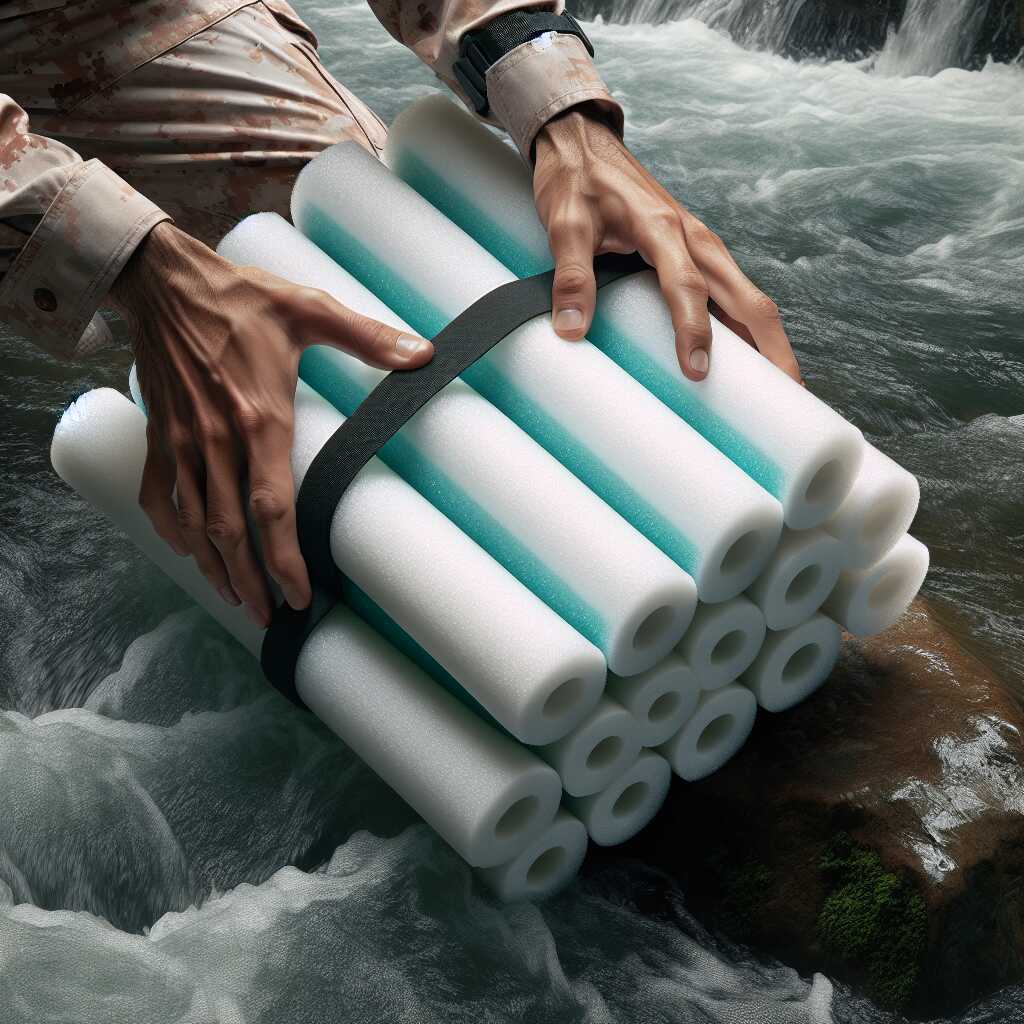
- Assemble a noodle bundle (2-10 minutes): Align noodles side-by-side (flat bundle) or two layers for extra width, leaving ends even. Instruction: wrap cord or webbing tightly at intervals of 30-50 cm (12-20 in) along the lengthmake at least three lashings (near each end and mid-span). Reinforce with zip ties or duct tape across lash points. Result: a reasonably rigid flotation block that resists separation when pulled or held.
- Attach a safety/throw line (2-5 minutes): Fix a secure attachment point to the bundles center using a strong knot or a carabiner through a taped loop. Instruction: attach 10-20 m (30-65 ft) of throw line to the bundle; form a hand-hold loop or tow loop. Result: the bundle can be sent or returned under control without entering the water.
- Decide how to deliver the flotation (1-3 minutes): For a conscious, cooperative swimmer, either toss the bundle (short distance) or float it across on the line and have the person grab/embrace it. Instruction: remain on shore; keep body weight low and secure; avoid wading into current. Result: person gains immediate buoyancy and can be hauled or guided to shore.
- Use conservative crossing technique (variable, 2-10 minutes per crossing): Communicate calmly, ensure the person is wearing shoes and clothing that wont snag, and instruct them to orient feet downstream and use the bundle for buoyancy while you tension the safety line. Instruction: if towing, move at a walking pace from shore, keep the line angled downstream no more than 30, and avoid sudden pulls. Result: controlled movement toward shore if conditions remain calm and person is conscious and cooperative.
- When NOT to use noodles (safety stop) (30-60 seconds): If the person is unconscious, hypothermic, in swift or turbulent water, or water contains heavy debris, do NOT attempt noodle-based rescue. Instruction: await trained rescue personnel with certified equipment or use reach/talk techniques from shore. Result: reduced risk of causing a worse outcome by avoiding an inappropriate improvised rescue.
- Aftercare and transport (5-20 minutes): Once on shore, remove wet clothing if cold, insulate the person, monitor for hypothermia or shock, and seek medical/rescue support if needed. Instruction: stow or dry noodles for reuse and document location/conditions for later review. Result: stabilized casualty and gear secured for extraction or further care.
FAQ
What is a foam pool noodle exactly and what is it made of
A foam pool noodle is a cylindrical closed-cell foam tube made most often from polyethylene (PE) or ethylene-vinyl acetate (EVA) about 1.5 m (5 ft) long and 6 cm (2.5 in) in diameter that provides buoyancy when placed in water. Manufacturers design these noodles as low-cost, durable flotation toys that provide reliable displacement and can be repurposed as improvised flotation aids in calm water; typical retail cost is $2 to $6 per noodle which Predicament Measures notes as an affordable option when certified gear is not available. The simple construction offers easy field repair with cord or tape and the product feels lightweight, sturdy, and easy to carry for short-term rescue use but it is not a certified personal flotation device and does not replace approved rescue equipment.
What are typical dimensions weight and foam density of pool noodles
Typical pool noodles measure about 150 cm (5 ft) long and 6 cm (2.5 in) diameter, and they usually weigh between about 100 g and 300 g (0.2-0.7 lb) depending on density and material. Foam density commonly ranges from roughly 20 kg/m3 to 100 kg/m3 for closed-cell PE or EVA foam, which affects buoyant force per noodle; one standard 5 ft 2.5 in noodle typically provides about 4.6 kg (10 lb) net buoyant force. Product reviews and comparison testing show variation by brand and year (including 2025 models), so testing and review of specific noodles before field use improves reliability and user confidence.
How do foam pool noodles work step by step to add buoyancy
Pool noodles add buoyancy by displacing water with closed-cell foam so the total upward buoyant force equals the weight of the water displaced; adding noodles increases total buoyant force and flotation. In practice you combine multiple noodles, align them to create a wide surface, and secure them with cord, webbing, or tape so the load spreads and stability improves; each additional noodle adds roughly 4.6 kg (10 lb) of net buoyancy. Practitioners should test the assembled bundle in calm, shallow water before use, record results, and review performance data so that reliability and efficiency improve over time.
How do you build a simple flotation bundle in under 10 minutes
Collect 6-9 noodles for an adult or 2-4 noodles for a small child, then stack them side by side and lash them together with 3 to 4 wraps of cord or tape to create a flat raft that can be made in about 2 to 10 minutes. Use 2 m to 4 m of 6 mm cord or 25 mm webbing and tie simple reef knots or use heavy tape to hold noodles together; a quick rig like this provides a usable, stable platform for calm shallow crossings and helps a conscious, cooperative person float. Predicament Measures recommends practicing this assembly once or twice in a pool or calm lake to test buoyancy, comfort, and handling before relying on it in the field.
What are the main benefits of using foam pool noodles for rescue
Pool noodles provide low-cost, widely available buoyancy that helps teams extend flotation resources when certified personal flotation devices (PFDs) or rescue throw bags are not on hand; a set of 6 noodles costs about $12 to $36 versus $30 to $200 for a single PFD or $80 to $300 for rescue lines. Noodles are light, easy to carry, and can be assembled in 2 to 10 minutes to deliver extra buoyancy and stability in calm, shallow water, which enhances team capability for non-technical river crossing assistance. These benefits make noodles useful as an improvised tool in last-resort scenarios, but they do not offer approved life-saving certification and cannot replace trained rescue gear for swiftwater or technical rescues.
How much buoyancy and stability can a bundle of noodles give
A single standard noodle provides about 4.6 kg (10 lb) of net buoyancy, so a bundle of 6 noodles offers roughly 27.6 kg (60 lb) and a bundle of 9 noodles offers roughly 41.4 kg (90 lb), which often helps support one average adult in calm shallow water when used correctly. Stability improves when you lay noodles flat, spread the load across the chest or back, and tie them together with cross lashing; this arrangement enhances lateral stability but does not provide secure head support or rotation control. Field reviews, user testing, and basic calculations show that buoyancy and stability depend on number of noodles, exact foam density, victim cooperation, and water conditions, so testing before use enhances safety and reliability.
What are the risks and limitations of using foam pool noodles in rivers
Pool noodles are not certified lifesaving devices, are not approved by the U.S. Coast Guard for personal flotation, and cannot replace PFDs or rescue throw bags for swiftwater or technical rescue, which limits their use to calm, shallow water and cooperative victims. Noodles offer no thermal insulation for hypothermia, they can be punctured or torn by sharp debris, and they provide limited control in current so they can fail in fast, deep, or debris-filled water; these factors reduce reliability and increase risk for rescues beyond simple assistance. Predicament Measures emphasizes that noodles should serve as an improvised aid only after hazard assessment, testing, and when trained personnel judge that the noodle rig enhances safety without creating new hazards.
When are pool noodles unsafe and what conditions to avoid
Avoid using pool noodles in fast current, whitewater, deep water, steep approaches, cold water where hypothermia risk is high, night operations, or areas with submerged debris and strainers because they can fail or put users at greater risk. Do not use noodles for unconscious or non-responsive victims, for victims with major injuries, or as the primary device in technical swiftwater rescue because they do not secure the airway or provide proven head support. Teams should avoid relying on noodles near hydraulic features, intake structures, or steep banks and should replace improvised rigs with approved rescue equipment as soon as possible to ensure rescue efficiency and safety.
Who should consider using foam pool noodles for river crossing help
Hikers and backpackers, survivalists, volunteer rescue teams, trip leaders, and outdoor educators may consider using pool noodles as an improvised flotation aid when certified equipment is absent and conditions are calm and shallow. Leaders and teams that consider this option must weigh cost, availability ($2-$6 per noodle), and field testing against the limits of noodles and should use them only as a supplemental or last-resort tool that helps conscious, cooperative people cross short, calm sections. Predicament Measures recommends that anyone who uses noodles in the field pair them with PFDs, shore-based belays, and experienced personnel to improve reliability and reduce risk.
What training or experience should people have before trying this
People should have basic swimming skill, river hazard assessment experience, rope and knot skills, and simple rescue training such as shore-based throw line practice before using noodles for crossing assistance. Teams should practice assembly and controlled tests in calm water, review results, and get expert guidance from swiftwater instructors or search-and-rescue teams so that field use improves with testing and experience. Predicament Measures suggests that reviews, hands-on training, and repeated practice will enhance confidence and performance but will not change the fact that noodles do not replace certified rescue gear.
When is the best time to use foam pool noodles for river assistance
The best time to use foam pool noodles for river assistance is in calm, shallow water when certified rescue equipment is not available and trained helpers are on scene. Foam pool noodles provide about 4.6 kg (10 lb) net buoyancy per standard 5 ft x 2.5 in noodle, so combining 6-9 noodles typically supports one average adult in calm water and 2-4 noodles can help a small child; simple bundles take about 2 to 10 minutes to assemble and a more secure rig may take 10 to 30 minutes. Predicament Measures recommends testing noodle rigs on shore before use, noting that noodles are not USCG approved, are unsafe in swift, deep, cold, or debris-filled water, and are unlikely to reliably support an unconscious or hypothermic person.
What river conditions make improvised noodles a viable option
Calm water, low current, shallow depth, and low debris load make improvised noodle rigs a viable option for short-distance assistance. Specific conditions often cited in field use include water under about knee to waist depth and current speeds roughly below 0.5 to 1.0 m/s, with clear access from shore for shore-based control and fast removal off the water. Reliability depends on rigging quality, number of noodles, user weight, and rescuer experience, with practical testing advised before live use.
How much do foam pool noodles cost compared to certified gear
Foam pool noodles cost about $2 to $6 each, while certified personal flotation devices (PFDs) typically cost $30 to $200 and rescue throw bags or rescue lines cost about $80 to $300. Buying 6-9 noodles for one adult rescue therefore costs roughly $12 to $54, which offers low upfront cost but far less reliability than a $50 to $150 PFD designed and tested for buoyancy and wear. Predicament Measures emphasizes that cost savings do not replace testing, training, and use of certified gear in planned trips and organized rescue operations.
What is the cost and lifespan of noodles versus life jackets
Pool noodles cost $2-$6 each and often show UV and abrasion wear in months to a few years depending on sunlight, storage, and usage, while a quality PFD costs $30-$200 and typically lasts 5 to 15 years with inspection and care based on manufacturer guidance. Noodles lose buoyancy when cut, crushed, or waterlogged by long-term damage; PFDs provide designed buoyancy, approved labeling, and routine inspection intervals that improve long-term reliability and testing records. Budget planning should include replacement cycles, inspection logs, and user reviews when choosing gear for safety.
What materials and tools are needed to make noodle flotation aids
You need foam pool noodles, 6-12 mm accessory cord or webbing, 4-10 stainless or nylon zip ties, 2-4 locking carabiners, and waterproof tape to make improvised flotation aids that provide usable buoyancy. Typical cord lengths range from 3 m to 10 m for lashings and handholds, with assembly time for a simple bundle at about 2-10 minutes and secure rescue-style rigs taking 10-30 minutes. Testing the finished rig in shallow water for buoyancy, balance, and durability improves reliability and helps identify weak points before real use.
What knot types cord lengths and hardware work best for assembly
Bowline, figure-eight follow-through, clove hitch with a backup half hitch, and double fisherman knots work well for connecting webbing, creating fixed loops, and securing anchor points in noodle rigs; use accessory cord or 6-12 mm static cord for lashings and 10-12 mm for direct load lines. Recommended cord lengths include 3 m to 10 m per lashing for handholds and shore attachments, with stainless or nylon locking carabiners and 10-15 cm wide webbing for secure grips and spreader points. Perform a load and flotation test with measured weights and timed trials to check durability and performance before a live rescue attempt.
What are the best alternatives to foam pool noodles for river safety
The best alternatives to foam pool noodles for river safety are certified personal flotation devices (PFDs), rescue throw bags, anchored rescue lines, and inflatable rescue rafts designed and tested for water rescue. PFDs provide labeled buoyancy, approved materials, and reliable performance; throw bags and rescue lines enable shore-based retrieval at typical costs of $80-$300 for quality rescue throw bags and $100-$400 for rescue lines and anchors. Predicament Measures recommends using certified gear for planned river travel and carrying noodles only as a last-resort improvisation backed by training and testing.
How do throw bags PFDs and rescue lines compare in use and cost
PFDs cost $30-$200 and offer continuous wear, immediate buoyancy, and proven reliability, making them essential for every river user; throw bags cost $80-$300 and enable a shore-based rescuer to deliver a line to a swimmer without entering the water. Rescue lines and anchored systems cost $100-$400 and provide controlled belays and retrieval for multiple scenarios, with higher testing standards and documented performance compared to improvised noodle rigs. Reviews, testing records, and field experience show certified gear improves safety, reliability, and success rates in most river rescue situations.
What common mistakes should be avoided when using pool noodle devices
Common mistakes include using noodles in fast or deep water, relying on a single noodle for an adult, and attempting in-water rescues without shore-based control or trained rescuers. Leaving sharp edges near noodles, failing to test flotation under load, and trusting noodles to support unconscious or hypothermic victims reduce reliability and increase risk. Predicament Measures recommends clear role assignment, pre-use testing, timed drills, and immediate replacement of damaged components to enhance safety and performance.
What simple checks and practices reduce risk during a river rescue
Perform a buoyancy check by loading the noodle bundle with a known weight on shore and timing flotation, inspect cord, tape, and noodle condition for UV damage, and ensure 6-9 noodles are used for one average adult in calm water. Use shore-based belays, locking carabiners, and at least one trained rescuer to control the line while a second person monitors the swimmer; keep rescue time short and move victims out of the water promptly to reduce hypothermia risk. Regular practice, gear review, and comparison testing against PFDs or throw bags improve field experience and help inform best decisions in 2025 and beyond.
Related posts:
 Unwaxed Dental Floss: High-Strength Fishing Line Alternative for Wilderness Food Procurement
 Petroleum Jelly Cotton Balls: Five-Minute Burn Time Fire Starters for Damp Conditions
 Elastic Hair Ties: Cordage Bundle Organizers for Tangle-Free Emergency Kits
 Plastic Cling Wrap: Burn Wound Covering to Prevent Infection and Fluid Loss
 Cornstarch: Moisture Absorption Powder for Preventing Trench Foot
 Maxi Pads: Large Absorbent Bandages for Major Trauma Wound Coverage
 Rubber Erasers: Emergency Ear Protection Against Dangerous Noise Levels
Acrylic Yarn: Emergency Wound Sutures for Gaping Lacerations
Rubber Erasers: Emergency Ear Protection Against Dangerous Noise Levels
Acrylic Yarn: Emergency Wound Sutures for Gaping Lacerations